The Boy and the Wildlife Bridge
Aysel Banu YAVUZAL
- Category Children's Fairy Tales
- Format PDF
- Size 10.3 MB
- Views 1
Leo lives in a cozy house at the edge of town, where a busy road hums with cars all day long. One sunny morning his mother takes him for a drive, and Leo spots a frightened deer standing near the road, wanting to cross but held back by the fast traffic. His mother explains that busy roads are dangerous for animals, who cannot tell when it is safe. That night Leo cannot stop thinking about the deer, and he asks what people can do to help. When his mother mentions special bridges and tunnels built just for wildlife, Leo fetches his notebook, eager to learn more.
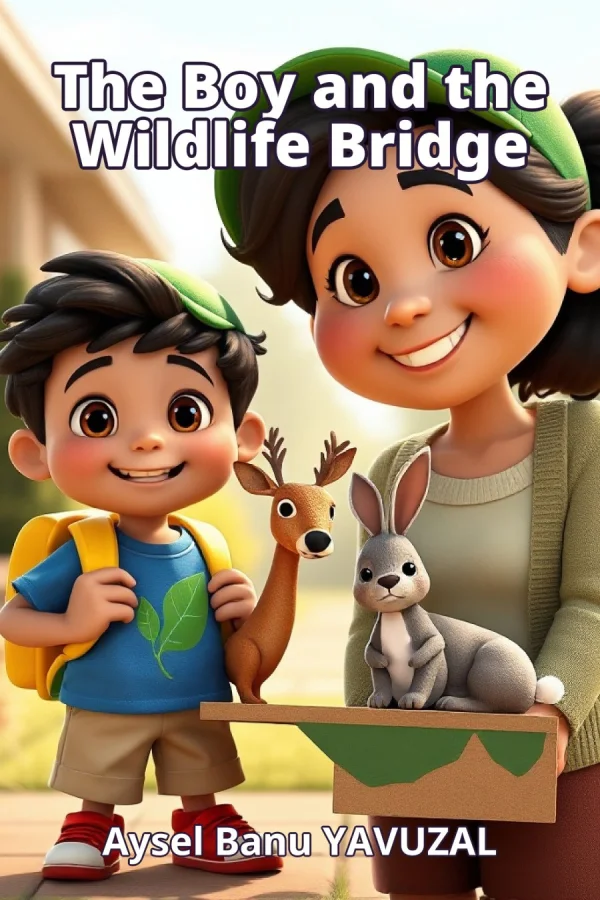
The next day Leo and his mother visit the library, where books show him how deer, rabbits and even bears use grassy bridges and tunnels to cross roads without harm. Inspired, Leo decides to build a model of his own. With cardboard boxes, glue, green paint and his mother's help, he constructs a busy road with clay cars, a wide bridge covered in felt grass and twig trees, and a tunnel for smaller animals. A toy deer with a white chest patch stands on the bridge, a rabbit with a red ribbon waits at the tunnel, and a fox, a hedgehog and a family of ducks each find their own safe way across.
When Leo shows the model to his friends and later to the neighbors, he explains simply that roads can consider wildlife and that people can share the world safely by planning carefully. The story follows Leo's curiosity from worry to action and shows young readers how observation, research and a handmade project can turn concern for animals into something others understand and admire. It suits children who enjoy animals and building things, and families looking for a gentle introduction to the idea that human roads and wild creatures can coexist.
Read the Book
If the PDF does not appear, open it in a new tab.
A Chapter from the Book
The Boy and the Wildlife Bridge - Author : Aysel Banu YAVUZAL
Leo lived in a cozy house at the edge of town, where the busy road hummed with cars all day long. He often watched the traffic zoom past from his bedroom window, wondering where all those cars were going. One sunny morning, his mom packed a canvas tote bag with snacks and said, 'Let's go for a drive, Leo!' Leo grabbed his yellow backpack and green cap, ready for an adventure. 1
As they drove, Leo pressed his nose to the window and saw a deer standing near the road, looking scared. 'Mom, look!' he cried. 'That deer wants to cross, but the cars are too fast!' His mom slowed down and said gently, 'Busy roads can be dangerous for animals, Leo. They don't know when it's safe.' Leo's big brown eyes grew wide with worry as the deer turned back into the woods. 2
That night, Leo couldn't stop thinking about the deer. He asked his mom, 'What can we do to help animals cross roads safely?' She smiled and said, 'I've heard of special bridges and tunnels just for wildlife. They help animals travel without getting hurt.' Leo's round face lit up with a gap-toothed grin. 'I want to learn more!' he said, and he ran to fetch his notebook. 3
The next day, Leo and his mom visited the library. They found books with pictures of wildlife bridges and tunnels. Leo learned that deer, rabbits, and even bears use these safe paths to cross busy roads. 'Look at this one!' Leo pointed. 'It's a bridge covered in grass and trees, and animals walk right over the road!' His mom nodded. 'People planned carefully so animals can stay safe.' 4
Leo decided to build a model to show everyone how wildlife crossings work. He gathered cardboard boxes, glue, and green paint. His mom helped him cut out arches for tunnels and a bridge with tiny trees. Leo worked all afternoon, his small hands busy and his green cap slightly askew. 'This will be the best model ever!' he declared, adding a tiny blue collar to his toy deer. 5
First, Leo built the busy road with little cars made of clay. Then he added a wide bridge covered in green felt grass and tiny twig trees. 'This is where the deer will cross,' he said, placing his toy deer on the bridge. The deer had a white chest patch and slender legs, and it stood proudly on the safe path. Leo smiled, imagining real animals using such a bridge. 6
Next, Leo made a tunnel under the road for smaller animals. He used a cardboard tube and covered it with brown paper. 'The rabbit can hop through here,' he said, and he placed a small grey-brown rabbit with a red ribbon on its ear at the tunnel entrance. The rabbit's fluffy tail wiggled as if it were ready to hop. Leo clapped his hands. 'This is perfect!' 7
Leo added more animals to his model: a fox, a hedgehog, and a family of ducks. Each had its own safe way to cross. He painted tiny paw prints on the bridge and put little signs that said 'Animal Crossing.' His mom brought him a snack and said, 'You're teaching everyone how roads can consider wildlife.' Leo beamed. 'I want to show my friends tomorrow!' 8
The next day, Leo invited his friends to see his model. They gathered around the kitchen table, eyes wide with wonder. 'Wow! What is it?' asked his friend Mia. Leo explained, 'It's a wildlife bridge and tunnel! Animals use them to cross the road safely.' He showed how the deer walked over the bridge and the rabbit hopped through the tunnel. His friends cheered. 9
Leo's friends had questions. 'Do real animals use these?' asked Sam. Leo nodded. 'Yes! People build them in many places. They help animals travel without getting hit by cars.' Mia said, 'That's so cool! Can we help make more models?' Leo's gaptoothed grin spread across his face. 'Sure! We can build a whole wildlife crossing town!' They all laughed and started planning. 10
Leo's mom suggested they show the model to the neighbors. They set it up on a table in the front yard, and people stopped to look. Leo explained how the bridge and tunnel worked, pointing to the deer and rabbit. 'Roads should consider wildlife,' he said. 'We can share the world safely if we plan carefully.' The neighbors nodded and smiled, impressed by his clever idea. 11
One neighbor, Mr. Patel, said, 'Leo, your model is wonderful! It reminds me of a real wildlife bridge I saw on a trip. The animals learn to use it, and it keeps them safe.' Leo's eyes sparkled. 'See? It really works!' He felt proud that his model was teaching grown-ups too. His mom put her arm around him and said, 'You're making a difference, Leo.' 12
That evening, Leo's family gathered around the model. His dad asked, 'How did you come up with this idea?' Leo told them about the scared deer by the road and how he wanted to help. 'I learned that people can build safe paths for animals,' he said. 'And we can all help by caring.' His family clapped, and his little sister hugged him tight. 13
Leo's model stayed on display at school for a whole week. His teacher, Ms. Garcia, said, 'Leo, you've taught us all something important. Roads should consider wildlife.' Leo stood proudly by his model, wearing his green cap and blue T-shirt with the leaf print. He showed each class how the deer and rabbit crossed safely. Everyone loved his clever idea.
This section is a preview taken from the book (about 951 words). To continue, read the book or download the PDF.
Book Details
- Book
- The Boy and the Wildlife Bridge
- Author
- Aysel Banu YAVUZAL
- Category
- Children's Fairy Tales
- Language
- English
- Format
- PDF · 10.3 MB
- Pages
- 18
- Words
- about 1,078
- Published
- masalizle.com
- Access
- Free to read and download; for personal use only, all rights belong to the author.
Frequently Asked Questions
Is the PDF of The Boy and the Wildlife Bridge free?
Yes. The Boy and the Wildlife Bridge can be read and downloaded for free on this site; no sign-up or payment is required.
How many pages is The Boy and the Wildlife Bridge?
The Boy and the Wildlife Bridge has 18 pages and about 1,078 words.
Which devices can I read The Boy and the Wildlife Bridge on?
It is a PDF; you can read it in your browser on a phone, tablet or computer, or download it and open it offline.
Who is the author of The Boy and the Wildlife Bridge?
The Boy and the Wildlife Bridge was written by Aysel Banu YAVUZAL; it is listed in the Children's Fairy Tales category.