The Boy and the Manta Ray
Aysel Banu YAVUZAL
- Category Children's Fairy Tales
- Format PDF
- Size 10.0 MB
- Views 1
Leo loves to draw, and his sketchbook and three sharp pencils travel with him everywhere. When his class visits the ocean research center, he expects to see giant fish, but nothing prepares him for Pearl, a manta ray gliding silently past the huge window like a kite through water. Dr. Maya, the friendly scientist with the wave logo on her shirt, introduces the children to the gentle giant and answers Leo's endless questions about how Pearl eats plankton, why her fins curl, and how far she travels across the sea.
As Leo learns more, he discovers that manta rays face real dangers: fishing nets, plastic rubbish and hunters. Troubled by this, he decides to act in the way he knows best. With Dr. Maya's help and his own careful drawings, he begins to create a guide that will teach other children about manta rays and how to protect them. The story follows his work from first sketches to a finished booklet and shows how curiosity, observation and a little determination can turn a school trip into something that matters.
Written for young readers, the book blends a warm friendship between a boy and a scientist with clear, accessible facts about manta rays and ocean conservation. It suits children who enjoy animal stories and drawing, and it offers parents and teachers a gentle starting point for conversations about protecting the sea. The lesson is simple and hopeful: people protect what they understand, and even a child with a sketchbook can help.
Read the Book
If the PDF does not appear, open it in a new tab.
A Chapter from the Book
The Boy and the Manta Ray - Author : Aysel Banu YAVUZAL
Leo zipped up his bright yellow rain jacket and stepped into the salty breeze. He held his small canvas satchel tight against his side. Inside was his sketchbook and three sharp pencils. Today he was visiting the ocean research center with his class. "I can't wait to see the giant fish!" he said, his dark brown eyes shining. 1
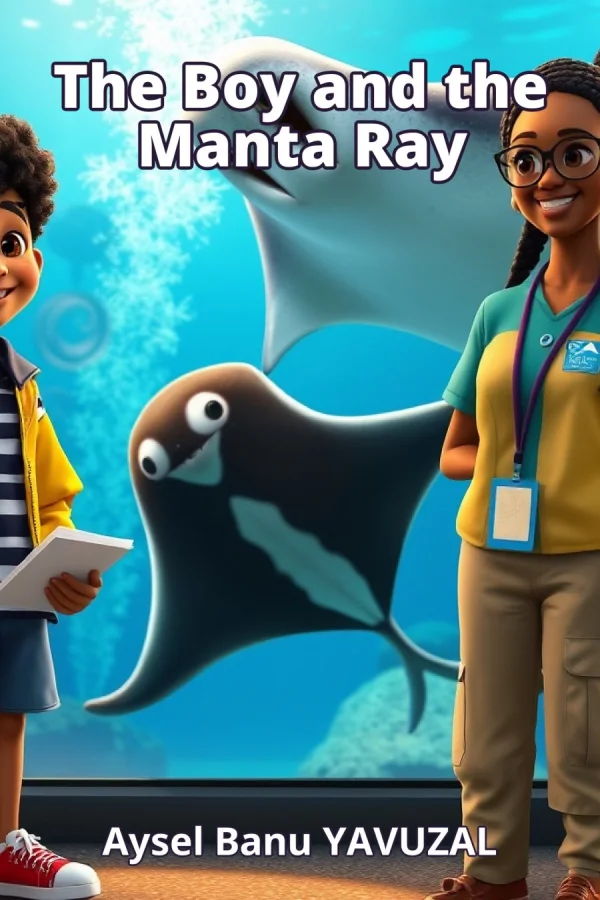
Dr. Maya met the class by the big blue doors. She wore a teal polo shirt with a little wave logo and a lanyard around her neck. Her round glasses sparkled when she smiled. "Welcome, young ocean explorers!" she said. "Today you'll meet some of the most amazing travelers in the sea. Follow me, and keep your eyes wide open." 2
The children walked past tall tanks full of shimmering fish and shelves of seashells. Leo spotted a huge window at the end of the hall. Something dark and wide was gliding slowly past the glass. He stopped and stared, his mouth open in a gap-toothed grin. "What is that?" he whispered. Dr. Maya knelt beside him. "That's Pearl," she said. "She's a manta ray." 3
Pearl glided past the window like a silent kite. Her wide diamond-shaped body was velvety charcoal-black on top, with soft pale patches near her shoulders. Her belly was white with dark speckles, like a night sky dusted with stars. Two long fins curled forward on either side of her face. Leo pressed his hands to the glass. "She's beautiful," he breathed. 4
"Pearl is about four metres across," Dr. Maya explained, spreading her arms wide. "But she's a gentle giant. Manta rays have no bones, only soft cartilage like your ears. And see those curled fins by her mouth? They're called cephalic fins. She uses them to sweep food right into her mouth." Leo sketched a quick drawing of the fins in his sketchbook. 5
"What does Pearl eat?" Leo asked, pencil still moving. "Tiny drifting animals called plankton," Dr. Maya said. "Pearl swims slowly with her mouth open, and the plankton flow right in. She eats thousands of them every day. Manta rays are some of the biggest fish in the whole ocean, but they only eat the tiniest food." Leo drew little dots floating into Pearl's open mouth. 6
Dr. Maya showed Leo a map on the wall. "Manta rays are amazing ocean travelers," she said. "Pearl has swum hundreds of kilometres across the sea. She follows the warm water and the plankton. We track her with that little blue tag near her wing." Leo traced the dotted line on the map with his finger. "She's like a real explorer!" he said. "Just like me." 7
Pearl looped slowly in the big tank, banking and turning with tiny movements of her wings. She seemed to fly through the water rather than swim. A school of small silver fish darted around her, and she paid them no mind at all. "She looks so calm," Leo said. "Manta rays are very curious and gentle," Dr. Maya told him. "They often swim right up to divers." 8
Then Dr. Maya's voice grew softer. "But manta rays need our help," she said. "Fishing nets can trap them, and plastic rubbish floats in their ocean home. Some people hunt them, too. Pearl is safe here, but her wild cousins need friends who care." Leo looked at Pearl gliding so peacefully. His heart felt a little heavy. "That's not fair," he said quietly. 9
Leo thought hard for a moment, his freckled nose scrunched up. Then his eyes went wide. "Dr. Maya!" he said. "What if I make a guide about manta rays? With drawings! Then other kids can learn about them and help keep them safe." Dr. Maya clapped her hands together. "That is a wonderful idea, Leo!" she said. "Let's find out everything we can together." 10
Dr. Maya showed Leo real manta ray facts and photographs. He learned that manta rays live for many years and are very smart. They visit cleaning stations where tiny fish nibble off old skin. He learned that they are slow to have babies, so every manta ray matters. Leo filled page after page with drawings. Pearl stretched her wide wings near the glass, as if she were posing. 11
Back home, Leo worked on his guide for days. He drew Pearl with her curled fins and her speckled belly. He wrote simple sentences: Mantas are gentle. Mantas eat plankton. Give manta rays space. Keep the ocean clean. He coloured the pages bright blue and green. On the cover he wrote in big letters: THE BOY AND THE MANTA RAY, A GUIDE FOR FRIENDS OF THE OCEAN. 12
Leo brought his finished guide to the research center. Dr. Maya held it up and smiled her warm smile. "This is exactly what the ocean needs," she said. "People protect what they understand. You've made it easy and friendly to learn about manta rays." Pearl glided past the window, and Leo felt sure she was saying thank you in her quiet, graceful way. 13
Soon Leo's guide was in every classroom and library corner. Kids read it and drew their own manta rays. Some picked up litter at the beach with their families. Others told grown-ups about keeping the ocean clean. Leo's teacher even invited him to read his guide aloud to the whole school. His gap-toothed smile was the widest it had ever been.
This section is a preview taken from the book (about 911 words). To continue, read the book or download the PDF.
Book Details
- Book
- The Boy and the Manta Ray
- Author
- Aysel Banu YAVUZAL
- Category
- Children's Fairy Tales
- Language
- English
- Format
- PDF · 10.0 MB
- Pages
- 18
- Words
- about 1,035
- Published
- masalizle.com
- Access
- Free to read and download; for personal use only, all rights belong to the author.
Frequently Asked Questions
Is the PDF of The Boy and the Manta Ray free?
Yes. The Boy and the Manta Ray can be read and downloaded for free on this site; no sign-up or payment is required.
How many pages is The Boy and the Manta Ray?
The Boy and the Manta Ray has 18 pages and about 1,035 words.
Which devices can I read The Boy and the Manta Ray on?
It is a PDF; you can read it in your browser on a phone, tablet or computer, or download it and open it offline.
Who is the author of The Boy and the Manta Ray?
The Boy and the Manta Ray was written by Aysel Banu YAVUZAL; it is listed in the Children's Fairy Tales category.