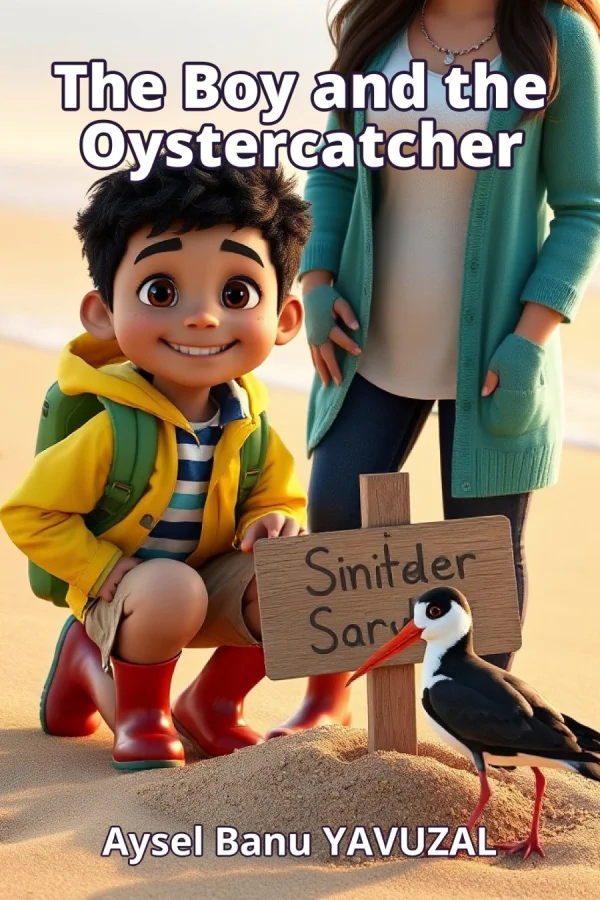
The Boy and the Oystercatcher
Aysel Banu YAVUZAL
- Category Children's Fairy Tales
- Format PDF
- Size 11.4 MB
- Views 1
Every morning, a young boy pulls on his red rubber boots and races to the beach, where he loves watching the oystercatchers with their glossy black-and-white feathers and bright orange-red bills. One day, he notices a pair of these shorebirds scraping a shallow nest in the open sand above the tide line. He learns from his mum that oystercatchers lay their eggs directly on the sand, with no grass or twigs to hide them, making the eggs vulnerable to footprints, beach balls, and unaware visitors.
Determined to help, the boy comes up with a plan: he and his mum paint wooden signs with a picture of an oystercatcher and clear words asking people to stay off the nesting area. As they place the signs on the busy beach, the boy sees that his efforts make a difference—people read the signs, ask questions, and promise to keep their distance. When a gust of wind smudges one sign, he patiently repaints it, showing his commitment to protecting the birds.
Weeks later, the boy is delighted to see three fluffy chicks running on the sand, proof that his signs helped keep the nest safe. This heartwarming story teaches children about the importance of caring for wildlife and shows how one small act of creativity and responsibility can make a big difference. It is perfect for young readers who love nature and want to learn how they too can help protect the environment.
Read the Book
If the PDF does not appear, open it in a new tab.
A Chapter from the Book
The Boy and the Oystercatcher - Author : Aysel Banu YAVUZAL
Every morning, the boy pulled on his red rubber boots and ran to the beach. He loved the salty wind and the crash of waves. Most of all, he loved the oystercatchers. They had glossy blackand-white feathers, long orange-red bills, and bright red eyes. He watched them dash along the sand on pink legs, poking their bills into the wet shore. 1
The boy's mum walked beside him in her teal cardigan. She carried a woven tote bag with snacks and a notebook. 'Look, Mum!' he said, pointing. 'That one has a little band on its leg.' Mum smiled. 'That's how scientists keep track of them,' she said. 'Oystercatchers are shorebirds, and they need our help.' The boy nodded, his dark-brown eyes wide. 2
One morning, the boy noticed something new. A pair of oystercatchers were scraping a shallow dip in the dry sand above the tide line. 'What are they doing?' he asked. Mum knelt down. 'They're making a nest,' she said. 'Oystercatchers lay their eggs right on the open sand. There's no grass or twigs to hide them.' The boy frowned. 'But anyone could step on them!' 3
The boy watched the nest every day. The oystercatcher sat low, its black-and-white feathers blending with the sand. Its red eyes scanned the beach. The boy saw footprints and a beach ball roll too close. 'Mum,' he said, 'visitors don't know about the nest. They might not see the eggs.' Mum nodded. 'That's why nesting areas need protection,' she said. 4
That evening, the boy had an idea. 'We could make beach signs!' he said. 'Signs that tell people to stay away from the nesting areas.' Mum smiled. 'That's a wonderful idea,' she said. 'We can paint them together.' The boy ran to get his green backpack. He pulled out paper and crayons. 'I'll draw an oystercatcher,' he said, 'so people know what to look for.' 5
The next day, they set up a small table in the garden. Mum spread out a big piece of wood. The boy painted a black-andwhite bird with a long orange-red bill. 'Look, Mum!' he said. 'It looks just like the real one.' Mum painted careful letters: PLEASE STAY OFF THE SAND — NESTING AREA. 'That will help visitors understand,' she said. 6
They made three signs, each with a bright picture and clear words. The boy painted a little arrow pointing away from the nest. 'So people know where to walk,' he explained. Mum tied a ribbon on each sign. 'These will catch the eye,' she said. The boy felt proud. His signs would help protect the shorebirds. 7
On Saturday, the beach was busy. Families spread out towels, and children built sandcastles. The boy and Mum carried the signs down the path. 'Where should we put them?' asked the boy. Mum pointed to the sandy area above the tide line. 'Near the nesting area,' she said. 'But not too close, so we don't disturb the birds.' 8
The boy hammered the first sign into the sand. A girl with a pink bucket stopped to look. 'What does it say?' she asked. The boy read it out loud. 'It says to stay off the sand because birds are nesting.' The girl nodded. 'I didn't know,' she said. 'I'll tell my brother.' The boy smiled. 'Thanks!' he said. 'Every little bit helps.' 9
They placed the second sign near the path. A man with a kite read it and nodded. 'Good idea,' he said. 'I'll keep my kite away from the nest.' The boy's mum smiled. 'Thank you,' she said. The boy felt a warm glow. People were listening. The oystercatcher sat on its nest, safe and sound. 10
Then a gust of wind blew the third sign over. The boy ran to catch it. 'Oh no!' he said. 'The paint is smudged.' Mum knelt beside him. 'Don't worry,' she said. 'We can fix it.' She pulled a small paint pot from her tote bag. The boy carefully repainted the orange-red bill. 'Good as new,' said Mum. The boy beamed. 11
As the sun began to set, the boy looked back at the nesting area. The oystercatcher stood beside its nest, its red eyes watching. The boy waved. 'We'll keep you safe,' he whispered. Mum put her arm around him. 'You made a big difference today,' she said. The boy leaned into her warm cardigan. He felt happy and proud. 12
Weeks later, the boy saw three fluffy chicks running on the sand. They followed their parents, peeping softly. 'They hatched!' the boy shouted. Mum clapped her hands. 'Your signs helped protect them,' she said. The boy watched the chicks learn to poke their bills into the sand. 'They're so cute,' he said. 'And safe.' 13
Other people began to help too. The girl with the pink bucket told her friends about the nesting area. The man with the kite flew it far away. Someone added a small flag to one of the signs. The boy smiled. 'People care,' he said. Mum nodded. 'They just needed to know,' she said. 'You taught them how to share the beach with shorebirds.' 14
The boy sat on a log and watched the oystercatcher family. The parent bird stood tall, its black-and-white feathers shining. It looked toward the signs and then toward the boy. 'I think it's saying thank you,' said Mum. The boy laughed. 'Maybe,' he said. 'But I'm the one who's thankful.
This section is a preview taken from the book (about 915 words). To continue, read the book or download the PDF.
Book Details
- Book
- The Boy and the Oystercatcher
- Author
- Aysel Banu YAVUZAL
- Category
- Children's Fairy Tales
- Language
- English
- Format
- PDF · 11.4 MB
- Pages
- 18
- Words
- about 978
- Published
- masalizle.com
- Access
- Free to read and download; for personal use only, all rights belong to the author.
Frequently Asked Questions
Is the PDF of The Boy and the Oystercatcher free?
Yes. The Boy and the Oystercatcher can be read and downloaded for free on this site; no sign-up or payment is required.
How many pages is The Boy and the Oystercatcher?
The Boy and the Oystercatcher has 18 pages and about 978 words.
Which devices can I read The Boy and the Oystercatcher on?
It is a PDF; you can read it in your browser on a phone, tablet or computer, or download it and open it offline.
Who is the author of The Boy and the Oystercatcher?
The Boy and the Oystercatcher was written by Aysel Banu YAVUZAL; it is listed in the Children's Fairy Tales category.