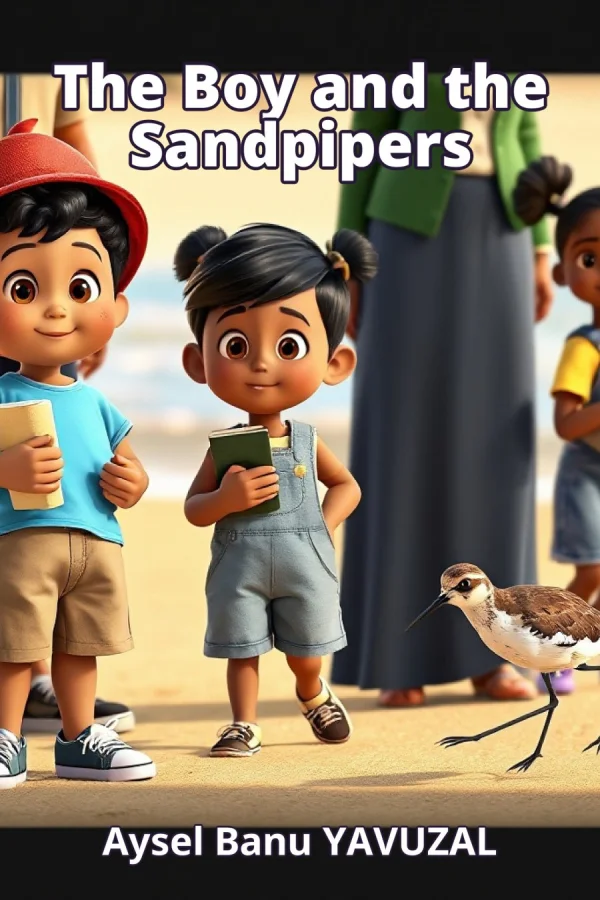
The Boy and the Sandpipers
Aysel Banu YAVUZAL
- Category Children's Fairy Tales
- Format PDF
- Size 10.7 MB
- Views 3
Every morning before school, Sam races to the shore with his red bucket hat and notebook to watch the sandpipers. He is especially fond of one with a silver band on its leg, which he names Pip. Sam records his observations and draws Pip, fascinated by the tiny bird's speed and delicate legs. At school, his teacher Mrs. Lee introduces the class to bird migration, explaining that sandpipers fly thousands of miles and need quiet beaches to rest and eat. Sam realizes that his own shore, busy with people and dogs later in the day, might not always be safe for the birds.
Inspired by Sam's sightings, the class decides to create a display to teach others about protecting coastal resting places. Sam contributes his notebook drawings, and his friend Maya paints a backdrop. Together with Mrs. Lee, they assemble a colorful exhibit with facts about sandpipers and a message to keep beaches clean and quiet. When the display is hung in the school hallway, Sam and Maya proudly explain it to younger children, sharing what they have learned and handing out paper sandpipers.
The story shows how a child's curiosity and careful observation can lead to meaningful action. It highlights the importance of protecting migratory birds and their habitats, and demonstrates that even small efforts can make a difference. Young readers will learn about sandpiper migration, the challenges these birds face, and simple ways to help them. The book is suitable for children in early elementary grades and for anyone who enjoys stories about nature, teamwork, and taking care of the environment.
Read the Book
If the PDF does not appear, open it in a new tab.
A Chapter from the Book
The Boy and the Sandpipers - Author : Aysel Banu YAVUZAL
Every morning, Sam raced to the shore before school. He wore his red bucket hat and carried a small notebook. The sandpipers were always there, racing along the wet sand on quick little legs. They looked like tiny clockwork toys, winding down and then springing forward again. Sam loved to watch them. He wrote in his notebook: 'Sandpipers are the fastest birds I know.' 1
One sandpiper had a tiny silver band on its right leg. Sam called it Pip. Pip had mottled brown and white feathers and a pale belly. It raced with the others, then rested on the quiet beach. Sam noticed how Pip's long thin legs carried it so fast. He drew a picture of Pip in his notebook and smiled. 'You're my favorite,' he whispered. 2
At school, Sam's teacher, Mrs. Lee, wore a green cardigan and round glasses. She had a bird-shaped pin on her lanyard. 'Today we'll learn about birds that travel far,' she said. Sam sat up straight. He thought of Pip and the other sandpipers. Mrs. Lee smiled at the class. 'Some birds fly thousands of miles every year. They need special places to rest and eat.' 3
Mrs. Lee pointed to a map with a long stick. 'Sandpipers fly from the far north all the way to the south,' she said. 'They stop at beaches along the way. But many beaches are busy with people and dogs. The birds can't rest.' Sam thought about his shore. It was quiet in the morning, but sometimes crowded later. He raised his hand. 'I see sandpipers every day,' he said. 4
The class leaned in as Sam told them about Pip. He showed his notebook with the drawing of the tiny bird. 'Pip races on the wet sand,' Sam said. 'And rests on the quiet part of the beach.' Maya, who sat next to him, grinned. 'Your drawing is great!' she said. Mrs. Lee nodded. 'Sam's sightings are important. We can help sandpipers by protecting their resting places.' 5
Mrs. Lee explained migration. 'Sandpipers need safe, quiet beaches to rest and eat during their long journey,' she said. 'When a beach is too crowded, the birds use up energy and can't finish their trip.' The class was silent, thinking. Sam imagined Pip flying for days, looking for a calm place to land. He wanted to help. 'What can we do?' he asked. 6
Mrs. Lee smiled. 'We can create a display to teach others about safe coastal resting places,' she said. The class buzzed with ideas. Maya raised her hand. 'I can paint the backdrop!' she said. Sam thought of his notebook. 'I can share my sightings,' he said. Mrs. Lee gave each student a job. Sam felt proud. His small notebook was going to help. 7
Maya painted a big blue sky and a golden beach. She added tiny sandpipers with quick legs. Sam cut out paper sandpipers and colored them brown and white. He made sure one had a silver band on its leg. 'That's Pip,' he told Maya. She laughed and painted a silver dot on the leg. The display began to look bright and lively. 8
Mrs. Lee helped the class write facts for the display. 'Sandpipers fly thousands of miles,' she read. 'They need quiet beaches to rest and eat.' Sam added a sign: 'Please keep beaches clean and quiet for our tiny travelers.' Maya painted a big heart around it. The class worked together, cutting, painting, and writing. The display grew more colorful and fun. 9
When the display was finished, Mrs. Lee hung it in the school hallway. It showed a sandy shore with sandpipers racing and resting. There was a big map with an arrow showing the migration route. Sam stood back and looked at it. He felt happy. 'Pip would be proud,' he said. Maya nodded. 'I think so too,' she said. 10
The next day, other classes came to see the display. Sam and Maya took turns explaining it. 'Sandpipers need our help,' Sam told a group of younger children. 'They need quiet beaches to rest.' The children listened with wide eyes. Sam felt brave and proud. He was sharing something important. Maya handed out small paper sandpipers to everyone. 11
Mrs. Lee smiled at Sam. 'You've taught us all something important,' she said. 'Your observations made a difference.' Sam looked at his notebook. He thought of Pip, racing on the shore. 'I hope Pip has a safe trip,' he said. Mrs. Lee nodded. 'Thanks to you and your class, more people will know how to help.' Sam felt warm inside. 12
That afternoon, Sam went back to the shore. The sandpipers were there, racing on their quick legs. Pip was there too, with its silver band shining in the sun. Sam sat quietly and watched. He didn't run or shout. He let the birds rest and eat. 'Safe travels, Pip,' he whispered. The little bird seemed to look at him before racing off again. 13
Sam opened his notebook and drew a picture of Pip with a big smile. He wrote: 'Sandpipers are tiny but brave. They fly very far. We can help them by keeping beaches quiet and clean.' He closed the notebook and watched the sun sparkle on the water. He felt happy and peaceful. The shore was a special place for birds and people.
This section is a preview taken from the book (about 902 words). To continue, read the book or download the PDF.
Book Details
- Book
- The Boy and the Sandpipers
- Author
- Aysel Banu YAVUZAL
- Category
- Children's Fairy Tales
- Language
- English
- Format
- PDF · 10.7 MB
- Pages
- 18
- Words
- about 1,023
- Published
- masalizle.com
- Access
- Free to read and download; for personal use only, all rights belong to the author.
Frequently Asked Questions
Is the PDF of The Boy and the Sandpipers free?
Yes. The Boy and the Sandpipers can be read and downloaded for free on this site; no sign-up or payment is required.
How many pages is The Boy and the Sandpipers?
The Boy and the Sandpipers has 18 pages and about 1,023 words.
Which devices can I read The Boy and the Sandpipers on?
It is a PDF; you can read it in your browser on a phone, tablet or computer, or download it and open it offline.
Who is the author of The Boy and the Sandpipers?
The Boy and the Sandpipers was written by Aysel Banu YAVUZAL; it is listed in the Children's Fairy Tales category.