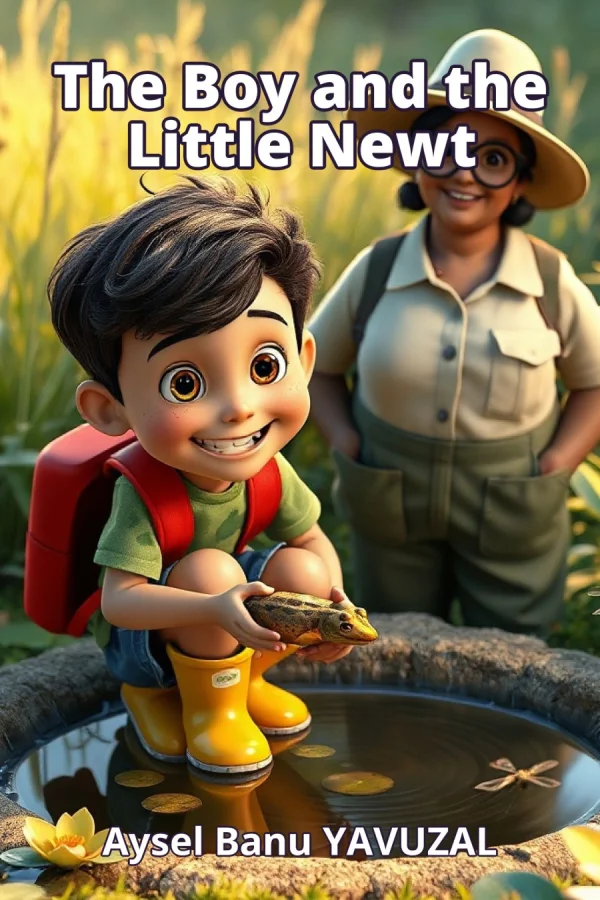
The Boy and the Little Newt
Aysel Banu YAVUZAL
- Category Children's Fairy Tales
- Format PDF
- Size 12.6 MB
- Views 1
On his way to school one bright Monday, Sam notices a small path he has never seen before and follows it to a tiny round pond hidden behind the school fence. There he meets a little newt no longer than his finger, with olive-brown skin, orange spots and a golden belly. Curious and gentle, Sam crouches at the water's edge and whispers a greeting to his tiny friend, and this quiet discovery sets the whole story in motion.
When Sam tells his class about the pond, his teacher Mrs. Reed explains that it is a wetland, full of life but fragile. The children visit together and find that the newts have few plants left to hide in, because the native plants were cleared away long ago. With Mrs. Reed's help, the class makes a plan and plants pickerelweed and arrowhead in the shallow water, learning that even a small wetland is a home for many living things.
Through Sam's patient watching, young readers see the pond slowly change: the water clears, water bugs and frogs return, and more newts appear among the fresh green stems. The story shows how careful observation and kind hands can protect the creatures around us, and it speaks to children who love nature, curious exploring and simple acts of care. It is a gentle read for early readers and for sharing aloud in the classroom.
Read the Book
If the PDF does not appear, open it in a new tab.
A Chapter from the Book
The Boy and the Little Newt - Author : Aysel Banu YAVUZAL
On a bright Monday morning, the boy walked to school with his red backpack bouncing. His name was Sam, and he loved to look at everything along the way. He wore his yellow rain boots just in case. Today, he noticed a small path he had never seen before, winding behind the school fence. "Where does that go?" he wondered, his hazel eyes wide. 1
Sam followed the little path past tall grass and buzzing bees. At the end, he found a small pond, round as a dinner plate, shining under the sky. Green plants floated on the water, and dragonflies zipped above it. Sam crouched down slowly, his freckled nose almost touching the surface. Something tiny wiggled in the shallows. 2
In the water swam a little newt, no longer than Sam's finger. Its olive-brown skin had a row of orange spots, and its golden belly glowed in the sunlight. It darted between the stems with a flick of its thin finned tail. Sam smiled so wide you could see the little gap in his front teeth. "Hello, tiny friend," he whispered. 3
The next day, Sam told his class about the pond. Mrs. Reed pushed her round glasses up her nose and smiled her bright smile. "That pond is a wetland," she said, "and wetlands are full of life." Her black hair was tied in a neat bun, and gardening gloves peeked from her pocket. "Let's visit it together," she said. 4
The whole class walked to the pond with Mrs. Reed in her canvas sun hat. The children leaned in to look, but the newts hid under the muddy edges. "Where did they go?" asked a girl. Sam pointed. "They need plants to hide in," he said. "But there aren't many here anymore." Mrs. Reed nodded slowly. "You are right, Sam." 5
Mrs. Reed explained that the pond once had many native plants. Long ago, some of them had been cleared away by mistake. Without plants, the water grew cloudy, and the little creatures lost their safe hiding spots. "Can we fix it?" Sam asked, his yellow boots sinking softly into the mud. "Yes," said Mrs. Reed. "Together, we can." 6
That week, the class made a plan. Mrs. Reed brought trays of native pond plants with names like pickerelweed and arrowhead. "These belong here," she said. The children took turns planting them in the shallow water, patting the mud gently around each root. Sam planted three plants himself, and his green leaf shirt got splashed with pond water. 7
Every day after that, Sam checked the pond. He watched the new plants settle in and the water grow clearer. Then one morning, he saw the little newt again, slipping between the fresh green stems. Its orange spots seemed brighter than ever. Sam felt warm and happy, like he had helped a friend find a cozy bed. 8
Soon the pond began to change. Tiny water bugs skittered across the surface, and frogs croaked from the reeds. Birds came to sip and splash. The little newts swam in quick little zigzags, chasing each other through the leaves. Sam counted four newts, then five. "The pond is busy!" he told Mrs. Reed, jumping with joy. 9
Mrs. Reed came to see the pond with the class again. "Look at all this life," she said, her round glasses shining. "Small wetlands may look little, but they are big homes for many living things." The children wrote about the pond in their notebooks. Sam drew the little newt with its orange spots and golden belly, adding a tiny smile. 10
One afternoon, a heavy rain fell on the school. Sam worried about the pond all through math class. When the clouds cleared, he ran outside with his yellow boots splashing. The pond was full and muddy, but the new plants held the soil in place, and the water was already clearing. "They're safe," he breathed. 11
Sam saw the little newt resting on a leaf, calm and still. It blinked its small round eyes at him, then darted away into the plants. Sam understood something important right then. Even a small pond, cared for with kind hands, can be a home for creatures that need it. He promised himself he would keep watching over it. 12
The class made a sign that said, "Please care for our pond and its newts." Sam painted a newt on it with orange spots. Mrs. Reed hung it on a post by the path. Now everyone who walked by could read about the wetland and its tiny neighbors. Sam felt proud to be one of its keepers, boots and all. 13
By summer, the pond was green and full of song. The newts had grown, and there were many more than before. Sam often sat on the grass after school, quiet as a stone, watching the gold bellies flash in the sun. He thought about how one small discovery had turned into something wonderful for the whole class. 14
Sam learned that you don't need a big forest or a wide lake to help nature. A little wetland behind a school can be just as precious. Every plant, every newt, every splash matters. When the plants grew back, the pond became busy and healthy again, humming with life. And the boy and the little newt were part of it all.
This section is a preview taken from the book (about 905 words). To continue, read the book or download the PDF.
Book Details
- Book
- The Boy and the Little Newt
- Author
- Aysel Banu YAVUZAL
- Category
- Children's Fairy Tales
- Language
- English
- Format
- PDF · 12.6 MB
- Pages
- 18
- Words
- about 965
- Published
- masalizle.com
- Access
- Free to read and download; for personal use only, all rights belong to the author.
Frequently Asked Questions
Is the PDF of The Boy and the Little Newt free?
Yes. The Boy and the Little Newt can be read and downloaded for free on this site; no sign-up or payment is required.
How many pages is The Boy and the Little Newt?
The Boy and the Little Newt has 18 pages and about 965 words.
Which devices can I read The Boy and the Little Newt on?
It is a PDF; you can read it in your browser on a phone, tablet or computer, or download it and open it offline.
Who is the author of The Boy and the Little Newt?
The Boy and the Little Newt was written by Aysel Banu YAVUZAL; it is listed in the Children's Fairy Tales category.