The Porcupine's Painting
Aysel Banu YAVUZAL
- Category Children's Fairy Tales
- Format PDF
- Size 12.5 MB
- Views 2
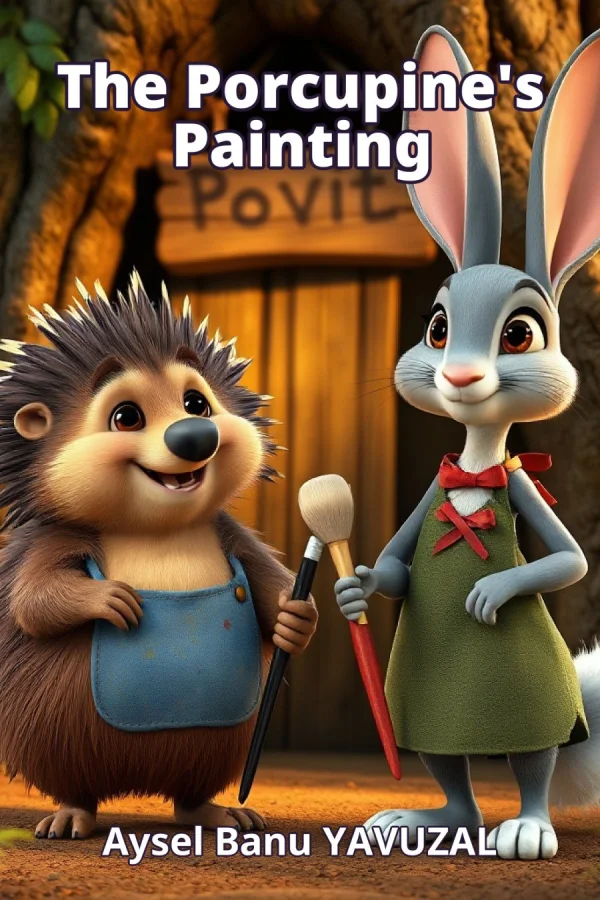
In the heart of the woodland, a small round porcupine named Pip dreams of painting the colors of the forest. His quills are sharp and his paws are tiny, but he hangs a sign on a hollow oak and opens Pip's Art Studio, welcoming anyone who wants to paint. When a rabbit named Clover hops by in her moss-green smock, the two discover that their styles are very different: Pip's quills leave scratchy lines and golden speckles, while Clover's soft brushes make smooth washes and fluffy clouds. At first their paintings look like two separate worlds stuck together, and both friends feel discouraged.
A breeze that flips one painting onto the other shows them something unexpected: Clover's clouds float over Pip's speckled ground, and his dots look like stars in her sky. From then on they mix their textures on purpose, painting the pond, the pebbly shore, the mossy rocks and the rough bark of an old oak together. Word spreads through the forest, and a squirrel, a hedgehog and a family of mice come to see the strange and lovely pictures. The friends decide to hold an exhibition celebrating how different textures can make something beautiful.
The story follows Pip and Clover as they prepare for the exhibition and face their own doubts about whether woodland friends will like their mixed-up art. Young readers learn that differences are not obstacles but ingredients, and that cooperation can turn what seems wrong into something whole. The gentle animal characters and the detailed woodland setting make this a warm read for children and for anyone sharing a picture book with them.
Read the Book
If the PDF does not appear, open it in a new tab.
A Chapter from the Book
The Porcupine's Painting - Author : Aysel Banu YAVUZAL
In the heart of the woodland, where the trees whispered secrets and the ferns curled like green ribbons, a small round porcupine named Pip had a big dream. He wanted to paint the colors of the forest, but his quills were sharp and his paws were tiny. One sunny morning, he hung a sign on a hollow oak: 'Pip's Art Studio – All Welcome!' 1
Pip wore a blue apron splattered with paint, and his quills— dark chocolate tipped with pale gold—bristled with excitement. He set out pots of berry-red and leaf-green, and brushes made from twigs. 'I'll paint the woodland,' he said, 'with dots and scratchy lines from my quills!' But when he tried, the quills made funny speckles that looked like rain. 2
Just then, a rabbit named Clover hopped by. She had long grey ears with pink lining, a moss-green smock with a red ribbon bow, and a fluffy white tail. 'What a lovely studio!' she said. 'May I paint too?' Pip's round eyes widened. 'Yes! But my quills make messy dots. Yours might be different.' Clover smiled. 'Let's find out!' 3
Clover unpacked her soft brushes and smooth paints. She painted a gentle wash of blue sky, soft as a cloud. Pip tried to paint a tree, but his quills left scratchy lines and golden dots. 'Oh no,' he sighed. 'My art is too spiky. Yours is so smooth.' Clover looked at her own painting. 'Mine is too plain,' she whispered. 'I wish I had your funny textures.' 4
They decided to paint side by side. Pip's quills made crackly grass and speckled stones. Clover's paws made fluffy clouds and silky streams. But when they stepped back, their paintings looked like two different worlds stuck together. 'Maybe our styles don't mix,' said Clover, her ears drooping. Pip's quills drooped too. 'Maybe not,' he said sadly. 5
That afternoon, a breeze blew through the studio and flipped Pip's painting onto Clover's. The scratchy lines landed right on her soft blue sky, and her fluffy clouds floated over his speckled ground. Pip gasped. 'Look! Your clouds are in my sky!' Clover's eyes sparkled. 'And your dots are like stars in my night!' Suddenly, their different art didn't look wrong—it looked like one woodland. 6
'Let's try mixing our textures on purpose,' said Clover. She painted a soft green meadow, and Pip rolled his quills over it, leaving golden dots like buttercups. Then Pip painted a scratchy tree trunk, and Clover dabbed fluffy white blossoms on the branches. 'It's like magic!' laughed Pip. 'Your softness makes my scratchiness look like bark!' 7
They painted the whole woodland together: Clover's gentle washes for the pond, Pip's speckled quills for the pebbly shore. Clover's fluffy tail brushed soft moss onto the rocks, and Pip's quills scratched the rough bark of an old oak. 'Our differences make the woodland look real,' said Clover. 'And wonderful,' agreed Pip, his round face beaming. 8
Word spread through the forest. Friends peeked into the studio: a squirrel, a hedgehog, and a family of mice. 'What strange and lovely paintings!' they cried. Pip and Clover looked at each other. 'We should have an exhibition,' said Clover. 'To show how different textures can make something beautiful.' Pip nodded. 'And to celebrate the woodland we love!' 9
They worked for days. Pip dotted golden stars across a twilight sky while Clover painted soft, sleepy clouds. Pip scratched the rough bark of trees, and Clover added fluffy green leaves. They mixed berry-red with leaf-green to make the brown of a deer's coat. Every painting was a blend of spiky and soft, scratchy and smooth—just like their friendship. 10
On the day of the exhibition, the studio buzzed with woodland friends. Pip felt a flutter in his cream belly. 'What if they don't like our mixed-up art?' he whispered. Clover touched his paw with her soft one. 'They'll love it because it's us.' She hung the last painting: a big woodland scene full of dots and lines and soft, fluffy washes. 11
The squirrel was the first to speak. 'I've never seen bark look so scratchy and real!' she said. The hedgehog pointed at the pond. 'And the water is so soft, I want to jump in!' The mice squeaked with delight at the golden dots that looked like fireflies. Pip's quills tingled with pride. Clover's ears stood tall. Their different styles had made something magical. 12
A little voice piped up from the back. 'Why are some parts scratchy and some parts soft?' It was a young rabbit. Clover smiled. 'Because Pip paints with his quills, and I paint with my paws. We mix our textures to show how the woodland is full of different things.' Pip added, 'And when we put our differences together, we make something better than either of us alone.' 13
The friends cheered and clapped. They asked for a painting of the whole woodland to hang in the hollow oak. Pip and Clover painted it together: scratchy tree trunks, soft clouds, speckled flowers, and fluffy moss. When it was done, everyone agreed it was the most beautiful woodland picture they had ever seen. 'It's all of us,' said Clover. 'And all our different ways,' said Pip. 14
From that day on, Pip and Clover were the best of friends. They painted every day, mixing textures and colors in new ways. Pip stopped worrying about his spiky quills, and Clover loved her soft paws even more. They learned that being different wasn't a problem—it was a gift. And their little studio in the hollow oak became the happiest place in the woodland.
This section is a preview taken from the book (about 943 words). To continue, read the book or download the PDF.
Book Details
- Book
- The Porcupine's Painting
- Author
- Aysel Banu YAVUZAL
- Category
- Children's Fairy Tales
- Language
- English
- Format
- PDF · 12.5 MB
- Pages
- 18
- Words
- about 1,009
- Published
- masalizle.com
- Access
- Free to read and download; for personal use only, all rights belong to the author.
Frequently Asked Questions
Is the PDF of The Porcupine's Painting free?
Yes. The Porcupine's Painting can be read and downloaded for free on this site; no sign-up or payment is required.
How many pages is The Porcupine's Painting?
The Porcupine's Painting has 18 pages and about 1,009 words.
Which devices can I read The Porcupine's Painting on?
It is a PDF; you can read it in your browser on a phone, tablet or computer, or download it and open it offline.
Who is the author of The Porcupine's Painting?
The Porcupine's Painting was written by Aysel Banu YAVUZAL; it is listed in the Children's Fairy Tales category.