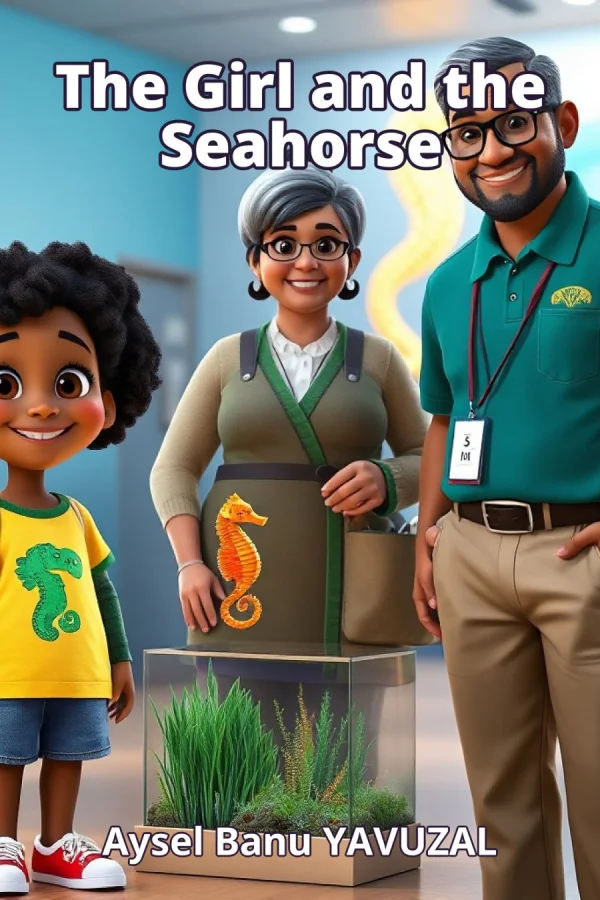
The Girl and the Seahorse
Aysel Banu YAVUZAL
- Category Children's Fairy Tales
- Format PDF
- Size 11.5 MB
- Views 2
Maya is a young girl who loves seahorses and dreams of becoming an expert. One day, she visits a marine conservation center with her Aunt Rosa, where Dr. Salim introduces her to Pip, a tiny pygmy seahorse living among seagrass. Maya learns that seagrass meadows provide essential shelter for seahorses like Pip, but these habitats are shrinking due to pollution and careless boat anchors. Inspired to help, Maya decides to create a model of a seagrass meadow to show others why it matters.
With Aunt Rosa's help, Maya builds a diorama using a shoebox, green paper, and clay. She carefully crafts seagrass blades and a miniature seahorse, complete with a numbered tag like Pip's. As she practices her presentation, Maya realizes she can also demonstrate the dangers of habitat damage by adding brown, droopy blades. Her model becomes a powerful tool to educate others about conservation.
This heartwarming story teaches children about the importance of protecting marine environments and how small actions can make a difference. Through Maya's curiosity and determination, readers learn about seahorse biology, the role of seagrass, and the impact of human activity on ocean habitats. The book is perfect for young readers who love animals and nature, encouraging them to become stewards of the environment.
Read the Book
If the PDF does not appear, open it in a new tab.
A Chapter from the Book
The Girl and the Seahorse - Author : Aysel Banu YAVUZAL
Maya skipped up the path to the marine conservation center, her red sneakers crunching on the shells. Her yellow t-shirt had a green seahorse printed on the front, and her canvas tote bag bumped against her hip. She couldn't wait to see the real seahorses inside. 'I've been waiting all week for this,' she told Aunt Rosa, who smiled and held the door open. 1
Aunt Rosa's silver-streaked bun bobbed as she nodded. 'I know, Maya. Dr. Salim is going to show us around.' Inside, a tall man in a teal polo shirt and thin glasses waved. His lanyard badge swung as he walked over. 'Welcome!' said Dr. Salim. 'I hear you're a seahorse expert already.' Maya grinned, showing the gap in her teeth. 'Not yet,' she said, 'but I want to be.' 2
Dr. Salim led them past tanks of shimmering fish. Maya pressed her nose to the glass, her dark brown eyes wide. 'Here's our seahorse nursery,' he said, stopping at a small tank filled with green, swaying blades. 'These are seagrass plants. Seahorses love them.' Maya peered in. At first she saw only green. Then something tiny moved. 'Oh!' she gasped. 'Is that a seahorse?' 3
'His name is Pip,' said Dr. Salim. 'He's a pygmy seahorse, only as big as your thumb.' Maya leaned closer. Pip had a goldenorange body with pale speckles, a long snout, and bright black eyes. His delicate fins fluttered like tiny fans. A small numbered tag clung to one fin. 'He's beautiful,' Maya whispered. 'Why is he hiding in the seagrass?' 'That's his shelter,' said Dr. Salim. 'Seagrass keeps him safe.' 4
Dr. Salim explained, 'In the ocean, seagrass meadows give seahorses a place to hide from big fish. Pip wraps his curled tail around a blade and rests.' Maya watched Pip curl his tail around a green stem. 'He looks like he's hugging it,' she said. 'Exactly,' said Dr. Salim. 'But seagrass meadows are shrinking. Pollution and careless boat anchors damage them. Without seagrass, seahorses have no shelter.' Maya frowned. 'That's terrible.' 5
Aunt Rosa put a hand on Maya's shoulder. 'Maybe we can help,' she said. 'What if we build a model of a seagrass meadow? Then everyone can see why it matters.' Maya's eyes lit up. 'Yes! We can show how Pip finds shelter among the swaying green blades.' Dr. Salim smiled. 'That's a wonderful idea. I'll give you some seagrass facts to use.' Maya pulled a notebook from her tote bag and started writing. 6
At home, Maya spread out her materials on the kitchen table. She had green paper, scissors, glue, and a shoebox. Aunt Rosa tied on her canvas apron and pulled out the scissors. 'Let's make the seagrass blades first,' she said. Maya cut long, wavy strips. 'Seagrass needs sunlight and clean water,' she said. 'So I'll add a blue background and a yellow sun.' She glued carefully, her curly puffs bouncing as she worked. 7
Next, Maya made a tiny seahorse from orange clay. She shaped a curled tail, a long snout, and added tiny black beads for eyes. 'Pip needs his numbered tag,' she said, so she drew a small tag on paper and taped it to the clay fin. Aunt Rosa helped her attach the seahorse to a thin string so it could hang among the paper blades. 'Now he can sway just like in the real ocean,' Maya said. 8
Maya practiced her presentation for Aunt Rosa. 'This is Pip,' she said, holding up the model. 'Pip is a tiny seahorse. He needs seagrass to hide and rest. The seagrass blades are like a safe green forest.' She moved the clay seahorse to show how it curled its tail around a blade. 'When the seagrass is healthy, Pip is safe and happy. But if the seagrass disappears, Pip has nowhere to hide.' 9
Aunt Rosa clapped. 'That's very clear, Maya. But how will you show what happens when the habitat is in danger?' Maya thought. 'I could make some blades droopy and brown,' she said. She cut a few paper blades shorter and colored them brown. 'These are damaged by pollution,' she explained. 'Then Pip can't find shelter.' She placed the clay seahorse near the brown blades and made it look sad. 10
The next day, Maya brought her model to the conservation center. Dr. Salim set up a table near Pip's tank. Maya's hands trembled a little as she began. 'This is a seagrass meadow,' she said. 'Seahorses like Pip need it to hide and rest.' She moved the clay seahorse through the green blades. 'See how Pip curls his tail and stays safe? The seagrass is his shelter.' A small crowd gathered to listen. 11
Maya showed the brown, droopy blades. 'When the ocean habitat is damaged, the seagrass dies. Then Pip has no shelter.' She looked at the crowd. 'Small animals need healthy habitats to stay safe and happy.' People nodded. A boy asked, 'How can we help?' Maya smiled. 'We can keep the ocean clean and protect seagrass meadows.' Dr. Salim beamed. 'Well said, Maya.' 12
After the presentation, Dr. Salim led Maya back to Pip's tank. 'You've taught everyone something important today,' he said. Maya watched Pip curl his tail around a real seagrass blade. 'Pip likes his shelter,' she said softly. 'I'm glad he has it.' Dr. Salim nodded. 'And thanks to you, more people will help keep it that way.' Maya felt warm and proud inside.
This section is a preview taken from the book (about 921 words). To continue, read the book or download the PDF.
Book Details
- Book
- The Girl and the Seahorse
- Author
- Aysel Banu YAVUZAL
- Category
- Children's Fairy Tales
- Language
- English
- Format
- PDF · 11.5 MB
- Pages
- 18
- Words
- about 1,138
- Published
- masalizle.com
- Access
- Free to read and download; for personal use only, all rights belong to the author.
Frequently Asked Questions
Is the PDF of The Girl and the Seahorse free?
Yes. The Girl and the Seahorse can be read and downloaded for free on this site; no sign-up or payment is required.
How many pages is The Girl and the Seahorse?
The Girl and the Seahorse has 18 pages and about 1,138 words.
Which devices can I read The Girl and the Seahorse on?
It is a PDF; you can read it in your browser on a phone, tablet or computer, or download it and open it offline.
Who is the author of The Girl and the Seahorse?
The Girl and the Seahorse was written by Aysel Banu YAVUZAL; it is listed in the Children's Fairy Tales category.