The Girl and the Salamander
Aysel Banu YAVUZAL
- Category Children's Fairy Tales
- Format PDF
- Size 12.6 MB
- Views 2
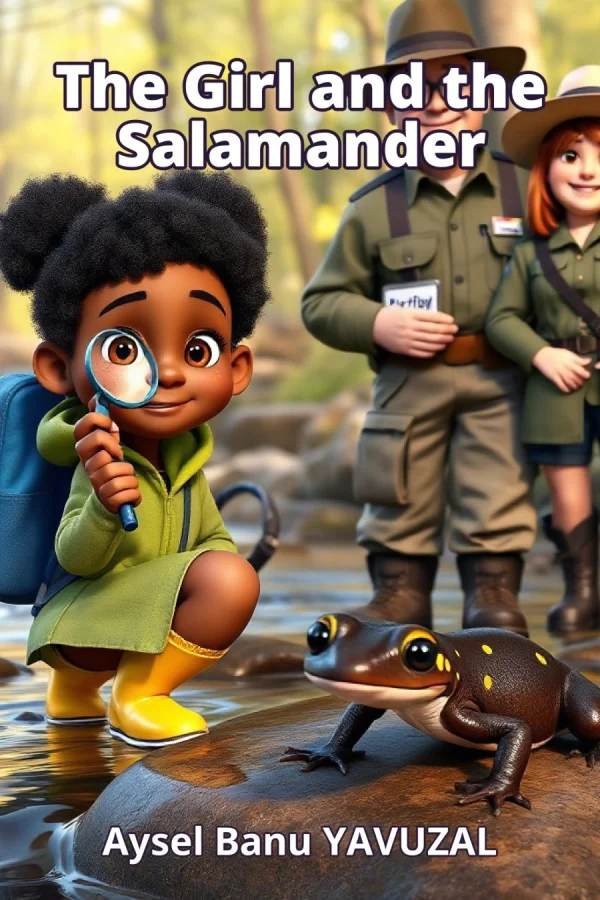
Maya loves exploring the woods behind her house after it rains, and one day she follows a new path to a small stream. Under a wet stone she discovers a little creature with glossy dark brown skin, bright yellow spots and big round eyes. Curious about what she has found, she brings her question to her teacher, Mr. Okafor, who explains that the animal is a salamander and that amphibians like it need clean water to live. That answer turns a simple nature walk into a question Maya cannot let go of: is the stream actually clean?
With Mr. Okafor and her classmates, and with help from Ms. Hartley, the park ranger, Maya learns how to test water, read the signs of pollution and understand why salamanders are described as tiny messengers about the health of a stream. When the children find a leaking pipe and clogged trash upstream, they start the Stream Savers project, cleaning the bank, planting bushes to filter the water and testing the stream week after week.
The story follows Maya from discovery to patient, practical action, showing young readers how scientists observe, ask questions and check their answers. It is a gentle introduction to freshwater habitats, amphibians and the idea that small, steady efforts can restore a place. The book suits children in the early school years, parents and teachers looking for a story that connects curiosity about nature with simple environmental responsibility.
Read the Book
If the PDF does not appear, open it in a new tab.
A Chapter from the Book
The Girl and the Salamander - Author : Aysel Banu YAVUZAL
Maya pulled on her yellow rain boots and her green hooded raincoat. She clipped her magnifying glass to her blue backpack and headed into the woods behind her house. The air smelled of wet leaves and moss. She loved exploring after a rain, when everything sparkled and dripped. Today, she followed a path she had never taken before. 1
The path led to a small stream that gurgled over smooth stones. Maya knelt on the muddy bank and peered into the clear water. Tiny fish darted between the rocks. She lifted a wet stone and gasped. Underneath sat a little creature with glossy dark brown skin and bright yellow spots. It had big round eyes and a long curled tail. 2
"Hello, little one," Maya whispered. The creature wiggled its tiny toes. Maya took out her magnifying glass to see it better. Its skin was shiny and damp. She watched it crawl slowly back under the stone. Maya wanted to know more about this amazing animal. She decided to ask her teacher, Mr. Okafor, about it the next day. 3
The next morning, Maya told Mr. Okafor all about the spotted creature. He smiled, his round glasses glinting. "That sounds like a salamander, Maya," he said. "They are amphibians, like frogs. They need clean water to breathe and live." Maya's dark brown eyes grew wide. "Clean water?" she asked. "How can we know if the stream is clean?" 4
Mr. Okafor picked up his clipboard and water-testing kit. "Let's find out," he said. He put on his wide-brimmed hat and led the class to the stream. The children carried nets and jars. Maya showed them where she had found the salamander. Everyone gathered around as Mr. Okafor explained how to test the water for pollution. 5
Ms. Hartley, the park ranger, met them by the stream. Her blue uniform was neat, and her name badge shone. She opened her canvas satchel and pulled out a map. "Salamanders are like tiny messengers," she said. "If the water is clean, they stay. If it is dirty, they hide or leave. They tell us how healthy the stream is." 6
The children tested the water. They checked for dirt and chemicals. They looked for wildlife under stones and in the mud. Maya found a few water bugs, but no salamanders. "They are hiding," she said. "That means the water might be polluted." Mr. Okafor nodded. "We need to find out what is making the stream unhealthy," he said. 7
The class followed the stream upstream. They found a pipe leaking dirty water into the brook. Leaves and trash were clogging the flow. "This is pollution," said Ms. Hartley. "It comes from things people leave behind." Maya felt sad. "The salamanders need clean water," she said. "We have to help them." Her curly puffs bobbed as she nodded firmly. 8
Back in class, the children made a plan. They called it the Stream Savers project. They would clean up the trash and tell others not to litter. They would plant bushes along the bank to filter the water. Maya drew a poster of a salamander with yellow spots and big round eyes. "Protect clean water, protect wildlife!" it said. 9
On Saturday, the class met at the stream with gloves and bags. Mr. Okafor brought his water-testing kit. Ms. Hartley brought extra maps and a big smile. They picked up cans, wrappers, and old tires. Maya worked hard, her yellow boots squelching in the mud. "We are making a difference," she said. The other children cheered. 10
After the cleanup, the children planted small bushes along the stream. They fixed the leaking pipe with help from the park rangers. Mr. Okafor tested the water again. "It is getting cleaner," he said. "But we must keep checking." Maya looked under a stone. No salamanders yet. "They will come back," she said. "We just have to be patient." 11
Weeks passed. The children took turns checking the stream. They picked up any new trash and tested the water. One sunny morning, Maya lifted a wet stone. There sat a salamander with yellow spots! Then another, and another. "They are back!" she shouted. The class gathered around. Ms. Hartley smiled. "Clean water brings them home," she said. 12
The salamanders thrived in the clean stream. Maya watched them swim and hide under stones. She felt proud of her class. They had worked together to protect the water. Mr. Okafor gave each child a Stream Saver badge. "You have shown that small actions make a big difference," he said. Maya wore her badge with a happy grin. 13
Maya returned to the stream often. She brought her magnifying glass and watched the salamanders. She showed her family the yellow spots and big round eyes. "They need clean water," she told them. "And we need to keep it clean for them." Her parents smiled and promised to help. Maya knew she would always be a friend to the stream. 14
The class continued their conservation project. They made posters for the school and the park. They told other classes about the salamanders. Soon, more people came to help. The stream grew cleaner and cleaner. Maya's teacher said, "You started something wonderful, Maya." She blushed, her freckles standing out. "We all did," she said. 15
One day, Maya sat by the stream and watched a salamander sun itself on a stone. Its yellow spots gleamed. She thought about how much the stream had changed. Clean water meant life for so many creatures. She promised to always protect it. And as the salamander slipped back into the clear water, Maya knew she had made a true friend.
This section is a preview taken from the book (about 954 words). To continue, read the book or download the PDF.
Book Details
- Book
- The Girl and the Salamander
- Author
- Aysel Banu YAVUZAL
- Category
- Children's Fairy Tales
- Language
- English
- Format
- PDF · 12.6 MB
- Pages
- 18
- Words
- about 955
- Published
- masalizle.com
- Access
- Free to read and download; for personal use only, all rights belong to the author.
Frequently Asked Questions
Is the PDF of The Girl and the Salamander free?
Yes. The Girl and the Salamander can be read and downloaded for free on this site; no sign-up or payment is required.
How many pages is The Girl and the Salamander?
The Girl and the Salamander has 18 pages and about 955 words.
Which devices can I read The Girl and the Salamander on?
It is a PDF; you can read it in your browser on a phone, tablet or computer, or download it and open it offline.
Who is the author of The Girl and the Salamander?
The Girl and the Salamander was written by Aysel Banu YAVUZAL; it is listed in the Children's Fairy Tales category.