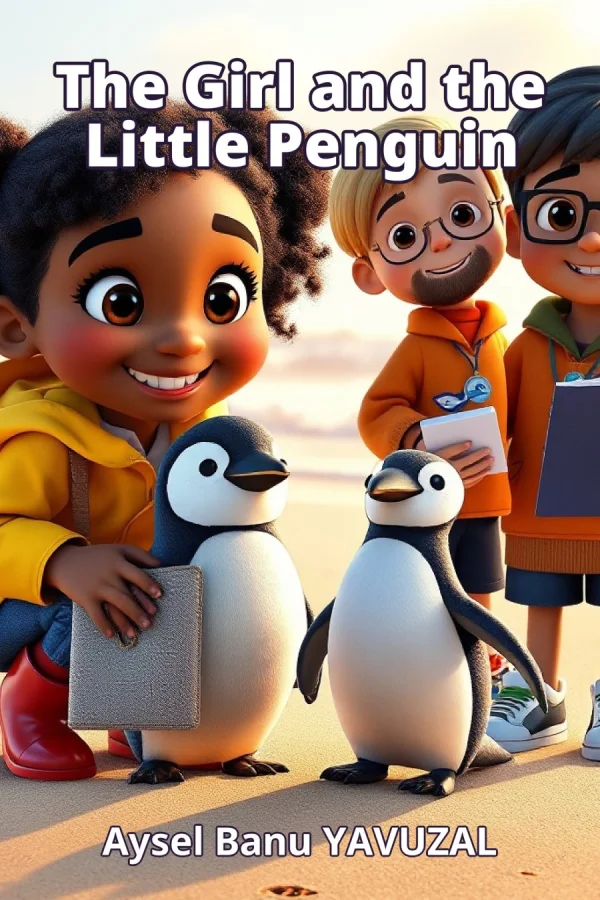
The Girl and the Little Penguin
Aysel Banu YAVUZAL
- Category Children's Fairy Tales
- Format PDF
- Size 11.9 MB
- Views 1
Maya is excited for a class trip to the ocean, where she and her best friend Leo explore the beach with their teacher, Mr. Okafor. Near a rock pool, Maya discovers a tiny blue-grey penguin with a plastic ring tangled around one flipper. With Mr. Okafor's help, the ring is carefully removed, and Maya names the little penguin Pip. When the teacher explains how plastic waste travels through the ocean currents and can harm animals far from where it started, Maya and Leo decide they have to act.
Back at school, Maya asks if the class can build a project about plastic in the ocean. The children create a poster and a model with blue yarn currents, showing how trash moves from rivers and beaches to distant wildlife. Leo draws a map with arrows tracing plastic around the world. At the school assembly, Maya shares simple tips — use fewer plastic bags, recycle, and pick up litter — and her classmates respond by making posters and bringing reusable water bottles.
Weeks later, Maya returns to the shore and spots Pip swimming safely, free of the plastic ring. She and Leo start an Ocean Helpers club, organizing beach clean-ups and encouraging families to reduce waste. The story shows young readers how curiosity and small, steady actions can protect wildlife, and it invites children, parents, and teachers to talk about plastic pollution and the difference a single caring child can make.
Read the Book
If the PDF does not appear, open it in a new tab.
A Chapter from the Book
The Girl and the Little Penguin - Author : Aysel Banu YAVUZAL
Maya pulled on her red rubber boots and zipped up her bright yellow raincoat. She was going to the ocean with her class today. Her curly black hair bounced in two puffy buns as she ran to the bus. In her canvas tote bag, she packed a snack and a water bottle. The ocean smelled salty and wild as they arrived. 1
Waves crashed and seagulls called. Maya's teacher, Mr. Okafor, wore his olive green cardigan and a lanyard with a whale badge. He smiled and said, 'Today we'll explore the beach and learn about ocean life.' Maya and her best friend Leo raced to the water's edge. Leo's orange hoodie flapped in the wind as he sketched the waves. 2
Suddenly, Maya heard a tiny squeak. Near a rock pool, a little penguin stood trembling. It was no bigger than her boot, with blue-grey feathers and a white belly. A plastic ring was tangled around one flipper. 'Oh, you poor thing!' Maya whispered. She knelt down slowly, her dark brown eyes soft and kind. The penguin blinked its big round eyes and didn't run away. 3
Maya called Mr. Okafor. He carefully removed the plastic ring and said, 'This little penguin is lucky you found it.' The penguin shook its flipper and let out a happy chirp. Maya named it Pip. 'How did the ring get here?' she asked. Mr. Okafor pointed to the waves. 'Plastic travels far in the ocean,' he said gently. 4
Mr. Okafor explained that plastic waste can float for miles, carried by currents. 'It can reach penguins and other animals in distant places,' he said. Maya's round cheeks flushed with worry. 'That's terrible!' she said. Leo nodded, his freckled nose wrinkling. 'We have to do something.' They watched Pip waddle back toward the sea, then disappear under the waves. 5
Back at school, Maya couldn't stop thinking about Pip. She raised her hand. 'Can we make a project about plastic in the ocean?' she asked. Mr. Okafor's hazel eyes crinkled with a smile. 'What a wonderful idea,' he said. 'We can show how plastic moves through marine ecosystems.' The whole class buzzed with excitement. 6
Maya and Leo began planning. Leo drew a big poster of the ocean with waves and animals. Maya cut out paper penguins, fish, and turtles. 'We'll show how plastic starts on land and ends up in the sea,' Maya said. Her gap-toothed smile shone as she glued a tiny plastic bottle onto the poster. Other kids painted blue waves and added plastic bits too. 7
The class built a model of the ocean with a current made from blue yarn. Small plastic pieces were placed on the yarn to show how trash travels. 'Plastic can move from a river to the sea and then to faraway places,' Mr. Okafor explained. Maya added a tiny penguin like Pip with a plastic ring on its flipper. 'So even penguins far away can get hurt,' she said softly. 8
Leo drew a map with arrows showing how plastic moves around the world. 'Look,' he said, 'plastic from one beach can reach another country's wildlife!' The class was amazed. Maya's best friend Leo grinned, his bright green eyes sparkling. 'We can teach others to help,' he said. They decided to present their project at the school assembly. 9
On assembly day, Maya wore her yellow raincoat for luck. She stood beside Leo and Mr. Okafor. 'This is Pip,' she said, pointing to a drawing of the little penguin. 'Plastic hurt Pip's flipper. But we can all help.' The audience listened as she shared simple tips: use fewer plastic bags, recycle, and pick up trash. 'Small actions make a big difference,' she said. 10
After the assembly, Maya's classmates wanted to help too. They made posters and placed them around the school. Some kids brought reusable water bottles. Others promised to clean up litter at the beach. Maya felt proud of her friends. 'We can keep the ocean clean for penguins and everyone,' she said. Her heart felt light and happy. 11
A few weeks later, Maya visited the ocean again. She scanned the waves, hoping to see Pip. Then, a tiny blue-grey shape popped out of the water. It was Pip! The little penguin swam close and chirped. Maya's eyes filled with happy tears. 'You're safe!' she called. Pip flapped its flipper, now free of plastic, and splashed playfully. 12
Maya knew there was still work to do. She and Leo started a 'Ocean Helpers' club at school. They organized beach cleanups and shared tips with families. 'Every piece of plastic we pick up is one less danger for wildlife,' Maya told the club. Mr. Okafor smiled proudly. 'You're making a real difference,' he said. 13
Maya's class project stayed on display in the school hallway. It showed how plastic travels through the ocean and how everyone can help. Kids stopped to look and learn. Maya often paused by the project, remembering Pip. She knew that even far away, ocean health mattered. 'We're all connected,' she whispered to herself. 14
One sunny afternoon, Maya sat on the beach with Leo and Mr. Okafor. They watched the waves and talked about their favorite sea animals. Maya thought about Pip and all the penguins out there. 'I'm glad we can help,' she said. Leo nodded and sketched a penguin in his notebook. 'Me too,' he said. The ocean sparkled in the sunlight.
This section is a preview taken from the book (about 916 words). To continue, read the book or download the PDF.
Book Details
- Book
- The Girl and the Little Penguin
- Author
- Aysel Banu YAVUZAL
- Category
- Children's Fairy Tales
- Language
- English
- Format
- PDF · 11.9 MB
- Pages
- 18
- Words
- about 976
- Published
- masalizle.com
- Access
- Free to read and download; for personal use only, all rights belong to the author.
Frequently Asked Questions
Is the PDF of The Girl and the Little Penguin free?
Yes. The Girl and the Little Penguin can be read and downloaded for free on this site; no sign-up or payment is required.
How many pages is The Girl and the Little Penguin?
The Girl and the Little Penguin has 18 pages and about 976 words.
Which devices can I read The Girl and the Little Penguin on?
It is a PDF; you can read it in your browser on a phone, tablet or computer, or download it and open it offline.
Who is the author of The Girl and the Little Penguin?
The Girl and the Little Penguin was written by Aysel Banu YAVUZAL; it is listed in the Children's Fairy Tales category.