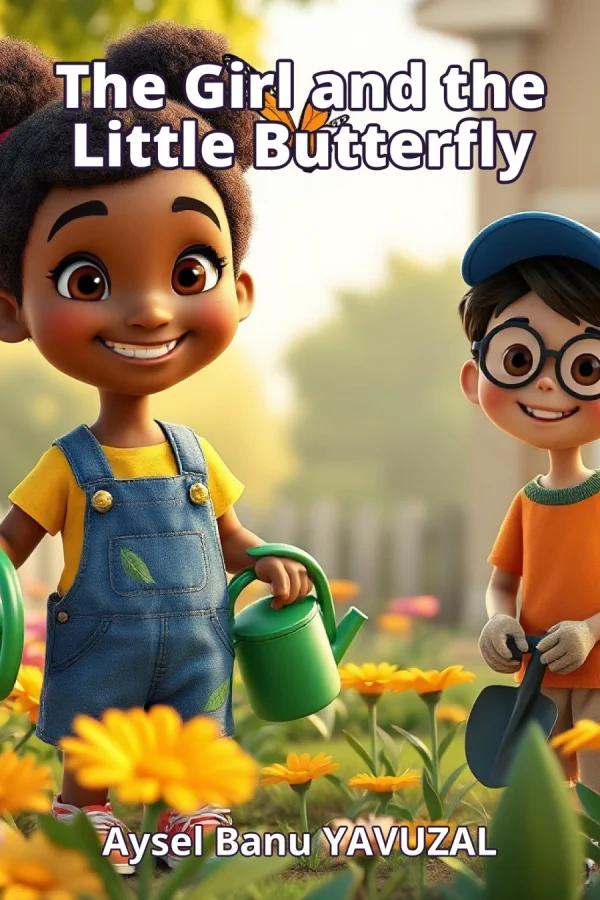
The Girl and the Little Butterfly
Aysel Banu YAVUZAL
- Category Children's Fairy Tales
- Format PDF
- Size 13.1 MB
- Views 1
Mia loves her garden more than anything, and every sunny morning she runs outside with her green watering can to tend the flowers and watch the bees. Her favorite visitor is a tiny butterfly with bright orange wings and black-edged edges, and she greets it each day with a gap-toothed smile. As she follows it from bloom to bloom, she begins to wonder what the little creature needs and why it never stays long in one place.
When her teacher, Ms. Lee, arrives at school wearing a butterfly pin, Mia learns that butterflies depend on native plants — flowers that have grown in the area for a very long time — to lay their eggs and find food. With her best friend Sam, who brings his blue cap and small shovel, Mia decides to start a butterfly garden behind the school. Ms. Lee shows them pictures of purple coneflowers, black-eyed Susans, and milkweed, and the two children plan, dig, and water, soon joined by classmates who want to help.
Weeks pass as the children wait patiently for tiny green shoots to appear. The story follows their work together and the moment their garden finally comes alive with color and fluttering wings. Through Mia's curiosity and care, young readers learn how native plants support biodiversity and give food and homes to butterflies, bees, and other small creatures. The book is suited to children in early primary school and to anyone who wants a gentle, practical introduction to helping nature in their own backyard.
Read the Book
If the PDF does not appear, open it in a new tab.
A Chapter from the Book
The Girl and the Little Butterfly Aysel Banu YAVUZAL
Mia loved her garden more than anything. Every sunny morning, she ran outside with her green watering can. She watered the flowers and watched the bees buzz. But her favorite visitor was a tiny butterfly with bright orange wings. It fluttered like a small leaf in the wind. Mia smiled her gaptoothed smile and whispered, "Hello, little butterfly!" 1
The butterfly danced over the flowers, its black-edged wings catching the light. Mia followed it from bloom to bloom. She noticed the small white dots on its wings. It seemed to be looking for something. Mia wondered, "What do you need, little friend?" She watched it land on a purple flower and rest. The butterfly seemed happy there, but it did not stay long. 2
One day, Mia's teacher, Ms. Lee, wore a butterfly pin on her green cardigan. Mia pointed at it and said, "I have a butterfly in my garden!" Ms. Lee smiled warmly. "Butterflies are wonderful," she said. "But they need special flowers to lay their eggs and find food." Mia's dark brown eyes grew wide. "Special flowers?" she asked. Ms. Lee nodded. "Native plants." 3
Ms. Lee explained that native plants are flowers that have grown in the area for a very long time. They give butterflies food and a place to raise their babies. "Without them, butterflies can't survive," she said. Mia thought about her little butterfly. She wanted to help. "How can I bring more native plants to my garden?" she asked. Ms. Lee said, "We can start a school garden together." 4
Mia was excited. She told her best friend, Sam, about the plan. Sam was tall for his age, with freckles across his nose. He wore his blue cap and carried a small shovel. "A butterfly garden? That sounds fun!" he said with a wide grin. "I can dig and plant. Let's do it!" Mia grabbed her green watering can. "We need native flowers," she said. "Let's ask Ms. Lee which ones." 5
Ms. Lee showed them pictures of native plants like purple coneflowers, black-eyed Susans, and milkweed. "These flowers feed butterflies and other insects," she said. "They also give them homes." Mia and Sam made a list. Sam put on his garden gloves. "I'll dig the holes," he said. Mia filled her watering can. "I'll water them," she said. They planned to start the garden behind the school. 6
The next day, Mia and Sam went to the school yard. Sam dug the soil with his small shovel. Mia carried her green watering can back and forth. Ms. Lee helped them place the little plants. "Native plants are tough," she said. "They don't need much water after they grow." Mia patted the soil around a milkweed plant. "This one will be for the butterflies' babies," she said. Sam wiped his forehead. "We need more helpers," he said. 7
Sam invited their classmates to join. Some kids brought trowels, and some brought watering cans. Everyone wanted to help. They planted coneflowers, asters, and butterfly weed. Mia showed them how to pat the soil gently. "These flowers will bring butterflies and bees," she said. "And birds, too!" added Ms. Lee. The children worked together, laughing and digging. The garden began to take shape. 8
Weeks passed, and tiny green shoots appeared. Mia visited every day with her watering can. She watched the plants grow taller and stronger. "When will the butterflies come?" she asked Ms. Lee. "Be patient," said Ms. Lee. "When the flowers bloom, they will find us." Mia looked at her little butterfly's favorite spot. She hoped it would return. She kept watering and waiting. 9
Then one morning, Mia saw a flash of orange. Her little butterfly was back! It fluttered over the new plants. "You came!" Mia cheered. The butterfly landed on a purple coneflower. Its black-edged wings opened and closed. Mia called Sam. "Look! It likes our garden!" Sam ran over with his shovel. "It's beautiful!" he said. They watched the butterfly sip nectar from the flower. 10
More butterflies appeared, and bees buzzed from bloom to bloom. The garden was full of color and fluttering wings. Ms. Lee came out and smiled. "You see?" she said. "Native plants support biodiversity. They give food and homes to butterflies and many other small creatures." Mia looked around. She saw ladybugs, bees, and even a tiny green frog. "Our garden is alive!" she said. 11
Mia wanted everyone to know about native plants. She made a poster with Sam. They drew butterflies and flowers and wrote: "Plant native flowers to help butterflies!" They hung it in the school hallway. Kids stopped to read it. Some asked, "Can we help in the garden?" Mia nodded. "Yes! We need lots of helpers." Soon, more classes wanted to plant their own native flower patches. 12
Ms. Lee helped Mia and Sam plan a garden day. Families came to plant and learn. Mia stood on a little stool and spoke. "Butterflies need native plants," she said. "And native plants need butterflies to help them make seeds. They help each other." Everyone clapped. Sam passed out seed packets. "Take some home!" he said. "Grow your own butterfly garden!" The children cheered. 13
By summer, the school garden was bursting with flowers. Butterflies floated like tiny orange kites. Mia's little butterfly had brought friends. They laid eggs on the milkweed. Soon, caterpillars munched on the leaves. Mia watched a caterpillar turn into a chrysalis. "It's like magic," she whispered. Sam said, "Our garden is a butterfly home!" Mia smiled her gaptoothed smile.
This section is a preview taken from the book (about 934 words). To continue, read the book or download the PDF.
Book Details
- Book
- The Girl and the Little Butterfly
- Author
- Aysel Banu YAVUZAL
- Category
- Children's Fairy Tales
- Language
- English
- Format
- PDF · 13.1 MB
- Pages
- 18
- Words
- about 1,077
- Published
- masalizle.com
- Access
- Free to read and download; for personal use only, all rights belong to the author.
Frequently Asked Questions
Is the PDF of The Girl and the Little Butterfly free?
Yes. The Girl and the Little Butterfly can be read and downloaded for free on this site; no sign-up or payment is required.
How many pages is The Girl and the Little Butterfly?
The Girl and the Little Butterfly has 18 pages and about 1,077 words.
Which devices can I read The Girl and the Little Butterfly on?
It is a PDF; you can read it in your browser on a phone, tablet or computer, or download it and open it offline.
Who is the author of The Girl and the Little Butterfly?
The Girl and the Little Butterfly was written by Aysel Banu YAVUZAL; it is listed in the Children's Fairy Tales category.