The Girl and the Crane
Aysel Banu YAVUZAL
- Category Children's Fairy Tales
- Format PDF
- Size 10.9 MB
- Views 3
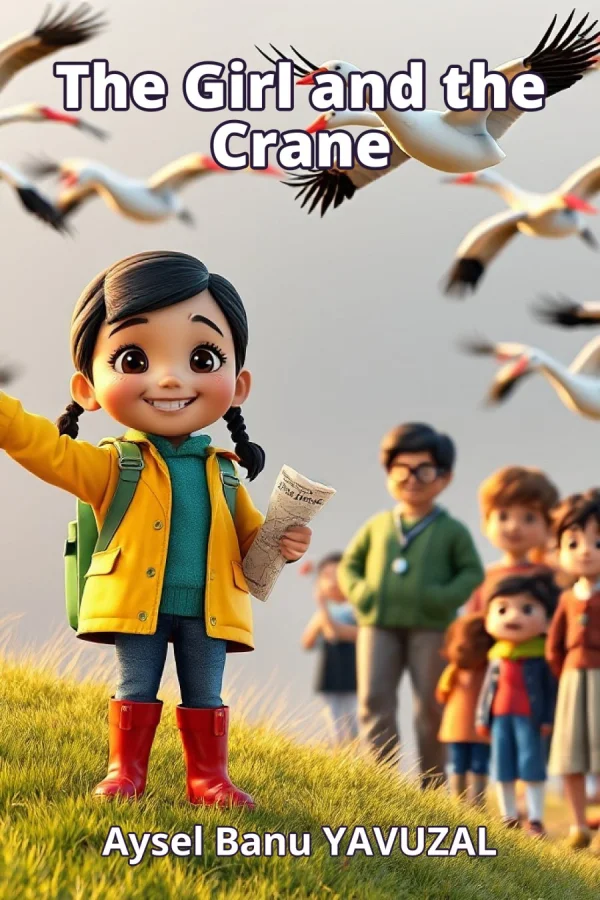
Every autumn, when the air turns cool and the leaves begin to fall, a girl in a mustard-yellow raincoat stands at the edge of town waiting for the cranes. With her two black braids flapping in the wind and a rolled-up map in her small green backpack, she watches the grey birds with their red crowns cross the sky in a long, graceful line. She wants to know where they go, so she unrolls her big map and decides to follow their migration, marking every lake, wetland and river delta where the cranes stop to rest and eat.
Day by day the map fills with little crane symbols, and the girl learns from her teacher that cranes depend on wetlands to survive their long journey. Then she notices a sign saying the wetland near her town might be filled in for a new parking lot. Troubled, she asks where the cranes will rest, and her teacher gently suggests that maybe she can help. That evening she traces the whole migration path on the living room floor and realizes that losing even one wetland makes the journey harder.
The next morning she brings her map to class and shows her classmates the places the cranes visit and the wetland that may disappear. Questions and ideas follow, and the children decide to write letters to the town leaders and make posters of grey cranes. The story shows young readers how curiosity, careful observation and a simple map can turn into shared action, and it introduces the idea that wetlands matter to the birds that depend on them. It suits children who enjoy nature stories and gentle lessons about working together.
Read the Book
If the PDF does not appear, open it in a new tab.
A Chapter from the Book
The Girl and the Crane - Author : Aysel Banu YAVUZAL
Every year, when the air turns cool and the leaves start to fall, the girl waits for the cranes. She stands at the edge of town in her mustard-yellow raincoat, her two black braids flapping in the wind. She carries a rolled-up map in her small green backpack. Then she hears them: a soft, wild call high above. The cranes are coming. Their wide grey wings stretch across the sky, and their red crowns glow like little lanterns. The girl smiles her gap-toothed smile and waves. 1
The cranes fly over the town in a long, graceful line. Their long necks reach forward, and their legs trail behind like thin ribbons. The girl watches until they are tiny specks. "Where do they go?" she wonders. She unrolls her big map on the grass. It shows lakes and rivers and faraway wetlands. She traces a path with her finger. "I will follow them," she says. "I will mark every place they visit." 2
At home, the girl spreads the map on the kitchen table. Her dark brown eyes shine as she studies the wetlands. She remembers what her teacher said: cranes need wetlands to rest and eat on their long journey. She picks up a pencil and draws a small crane symbol at the first lake near town. "This is where they stop first," she says. Her freckles crinkle as she smiles. She can't wait to follow the whole migration. 3
Each day after school, the girl checks the map. She reads about the places the cranes visit. She marks a wide, shallow lake where the cranes wade and eat water plants. She marks a muddy wetland where they rest for a week. She marks a river delta where they sleep standing on one leg. Her map fills with little crane symbols. Her small green backpack holds the map wherever she goes. 4
One afternoon, the girl visits the wetland near her town. She stands quietly in her red rubber boots. She sees cranes landing, their wide grey wings spread like sails. They dip their sharp beaks into the water and pull out tasty roots. The girl watches, patient and still. She draws a little crane on her map right there. "This wetland is like a rest stop," she whispers. "A place to eat and sleep." 5
But then the girl notices something. A sign at the wetland says it might be filled in for a new parking lot. Her round face falls. "Where will the cranes rest?" she asks her teacher the next day. Her teacher pushes her round glasses up and nods. "Wetlands are important," she says gently. "Maybe you can help." The girl holds her rolled-up map close and thinks hard. 6
That evening, the girl unrolls her map on the living room floor. She traces the whole migration path with her finger. From the lake near town, across the river delta, all the way to faraway wetlands. She marks each place with care. "If the cranes lose one wetland, the journey gets harder," she says. She decides to share her map with her classmates. Maybe they can help protect these places. 7
The next morning, the girl walks to school with her map rolled up tight. She wears her mustard-yellow raincoat, and her braids bounce as she hurries. In class, her teacher smiles warmly. "The girl has something to show us," she says. The girl unrolls the big map on the board. Her classmates gather around, curious. One boy in a blue cap asks, "What are all those little crane marks?" 8
The girl takes a deep breath. "These are the places the cranes visit on their migration," she says, pointing. "This lake, this wetland, this river. They need these places to rest and eat." Her classmates lean in closer. She shows them the wetland near town that might be filled in. "If we lose it, the cranes might not come back," she says softly. The room is quiet. Then hands shoot up with questions. 9
"How far do they fly?" asks a girl with a ponytail. "Do they sleep while flying?" asks another. The girl answers as best she can. "They fly for days," she says. "They need wetlands to stop and rest." Her teacher guides the discussion, her green cardigan sleeves rolled up. "What can we do to help?" she asks. The classmates think. "We can protect the wetlands!" says the boy in the blue cap. Everyone nods. 10
The class decides to make a plan. They will write letters to the town leaders asking them to save the wetland. They will draw pictures of cranes and make posters. The girl smiles so wide her gap tooth shows. She feels warm inside. Her map helped! Her teacher gives a proud nod. "You see," she says, "one person's idea can grow into something big when we work together." 11
The class works on their project for days. They paint posters with grey cranes and red crowns. They write facts about wetlands. The girl adds more crane symbols to her map. On the day of the town meeting, the girl stands up with her map. Her knees shake a little, but she speaks clearly. "Please save the wetland," she says. "The cranes need it." The grown-ups listen. They clap. The town leaders promise to think about it. 12
Weeks later, the town leaders agree to protect the wetland. They put up a new sign: "Crane Resting Place—Please Keep Clean." The girl visits with her class. They see cranes landing, dipping their beaks, and stretching their wide wings. The girl's freckles crinkle as she smiles. "They came back," she whispers.
This section is a preview taken from the book (about 950 words). To continue, read the book or download the PDF.
Book Details
- Book
- The Girl and the Crane
- Author
- Aysel Banu YAVUZAL
- Category
- Children's Fairy Tales
- Language
- English
- Format
- PDF · 10.9 MB
- Pages
- 18
- Words
- about 1,186
- Published
- masalizle.com
- Access
- Free to read and download; for personal use only, all rights belong to the author.
Frequently Asked Questions
Is the PDF of The Girl and the Crane free?
Yes. The Girl and the Crane can be read and downloaded for free on this site; no sign-up or payment is required.
How many pages is The Girl and the Crane?
The Girl and the Crane has 18 pages and about 1,186 words.
Which devices can I read The Girl and the Crane on?
It is a PDF; you can read it in your browser on a phone, tablet or computer, or download it and open it offline.
Who is the author of The Girl and the Crane?
The Girl and the Crane was written by Aysel Banu YAVUZAL; it is listed in the Children's Fairy Tales category.