The Girl and the Animal Map
Aysel Banu YAVUZAL
- Category Children's Fairy Tales
- Format PDF
- Size 13.3 MB
- Views 2
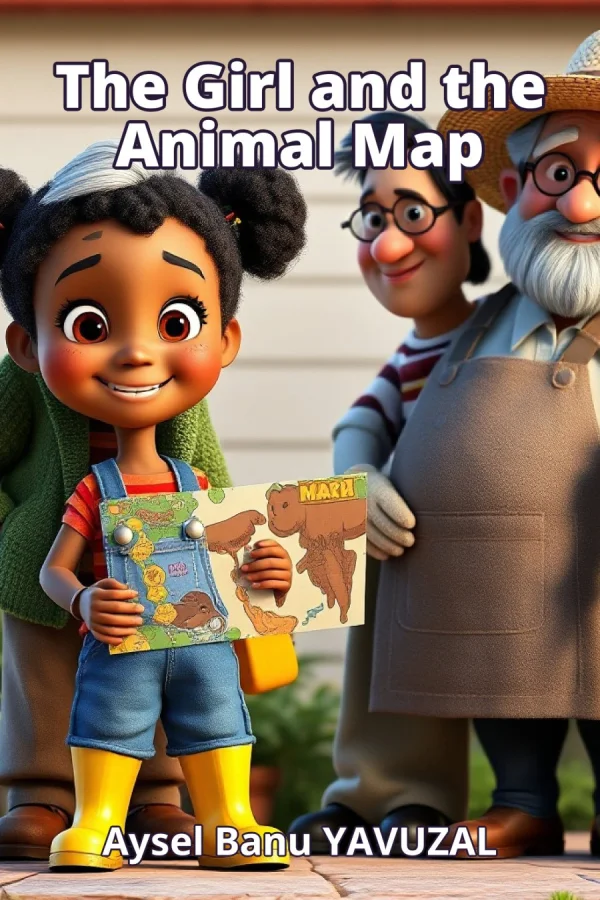
Mira is an eight-year-old girl who lives in a small village at the edge of a green wood. With her canvas satchel of rolled maps, colored pencils tucked behind her ear, and always-muddy yellow rain boots, she loves watching the animals near her home. Every morning she walks to the village edge with Grandpa Joseph, who teaches her to read the tiny tracks and signs that animals leave behind for those who notice.
One day Mira decides to draw an animal map. Working at the kitchen table and out in the fields, she marks the hedge where Pip the robin nests, the pond where frogs croak among the lily pads, and the narrow deer path that runs through the woods. Her map grows colorful and full of life, and when Neighbor Hana sees it she is astonished at how many animals live so close. Hana gathers the villagers, Mira explains each symbol, and the community begins to protect the nesting spots, clean the pond, and keep the deer path quiet.
The book follows Mira as her careful observation turns into something that brings a whole village together, and it closes with a nature day at the school where she shows other children how to spot animal signs and draw maps of their own. It is a gentle story about curiosity, patience, and the idea that knowing about the creatures around us is the first step toward caring for them. Young readers who enjoy nature, drawing, and stories about small ideas making a real difference will find much to like here.
Read the Book
If the PDF does not appear, open it in a new tab.
A Chapter from the Book
The Girl and the Animal Map - Author : Aysel Banu YAVUZAL
Mira lived in a small village at the edge of a green wood. She was eight years old, with curly black hair in two puffy buns and a gap-toothed smile. Her yellow rain boots were always muddy from exploring. She carried a canvas satchel filled with rolled maps and colored pencils tucked behind her ear. Mira loved to watch the animals that lived near her home. 1
Every morning, Mira walked to the village edge with Grandpa Joseph. He wore a wide-brimmed straw hat and leaned on his walking stick. 'Look closely,' he said, pointing at tiny tracks in the soft dirt. 'Animals leave signs for those who notice.' Mira knelt down and studied the marks. She wanted to remember every animal home she found. 2
One day, Mira had a big idea. 'I will draw an animal map!' she said. She unrolled a large sheet of paper on the kitchen table. With her colored pencils, she drew the village, the pond, and the woods. Then she began to mark where animals lived, one by one. Her map would show everyone the hidden homes around them. 3
Pip the robin followed Mira everywhere. He had a round orange breast and a tiny red thread tied loosely around one leg. Pip perched on Mira's shoulder as she explored the hedge. 'Cheep!' he sang, hopping toward a thick bush. There, tucked inside, was a robin's nest with three blue eggs. Mira carefully drew a nest symbol on her map. 4
Next, Mira visited the pond at the edge of the village. Frogs splashed among the lily pads, and their croaking filled the air. She marked the pond with a bright green frog symbol. 'This is where the frogs live,' she said. 'They need clean water and tall grass.' She drew little ripples around the pond on her map. 5
In the woods, Mira found deer tracks leading through the trees. The path was narrow and clear, a safe corridor for animals to travel. She followed the tracks until she saw a family of deer nibbling leaves. Quietly, she drew a deer symbol and a dashed line for their path. 'Animals need safe ways to move,' she whispered. 6
Mira worked on her animal map for many days. She marked where birds nest in the hedges, where frogs live in ponds, and where deer walk through the woods. Her map grew colorful and full of life. Grandpa Joseph smiled. 'You are showing us the homes we share,' he said. Mira felt proud of her careful work. 7
One afternoon, Neighbor Hana came to visit. She wore her garden hat and denim apron, and her gardening gloves were dusty. Mira showed her the animal map. Hana's eyes widened. 'I never knew so many animals lived so close!' she said. 'We should protect these places.' Mira nodded eagerly. Her map was already helping. 8
Hana called the neighbors together in the village square. Mira held up her map and explained each symbol. 'Here is a nesting spot,' she said, pointing to a hedge. 'And here is the frog pond. The deer path goes through these woods.' The neighbors listened closely. They wanted to help keep the animal homes safe. 9
The next day, everyone got to work. Some neighbors put small fences around the nesting spots so no one would step on them. Others cleaned the pond, pulling out litter and planting tall grass. They left the deer path open and quiet. Mira watched with a happy heart. Her map was bringing the whole village together. 10
Grandpa Joseph walked with Mira to check on the animals. The robins sang from their safe hedge, and the frogs croaked happily in the clean pond. Deer prints dotted the soft earth along the quiet path. 'Your map taught us to care for our neighbors,' Grandpa said. 'All our neighbors, big and small.' Mira smiled. 11
Pip the robin fluttered down and perched on Mira's shoulder. His red thread marker fluttered in the breeze. 'You helped too, Pip,' Mira laughed. She unrolled her map and added a new symbol: a tiny heart next to each protected place. The village was learning that knowledge supports conservation. 12
Hana organized a nature day at the village school. Mira brought her animal map and showed the children how to spot animal signs. They drew their own small maps of their gardens. 'Knowing about animal homes helps keep them safe,' Mira told them. The children promised to watch for nests and frogs and deer paths. 13
As the seasons changed, the village kept caring for the animal homes. The nesting spots stayed quiet, the pond stayed clean, and the deer path stayed open. Mira updated her map with new discoveries. She felt glad that her small idea had made such a big difference. The animals thrived, and the people felt closer to nature. 14
Grandpa Joseph gave Mira a new notebook for her maps. 'Keep exploring,' he said. 'There is always more to learn.' Mira tucked her colored pencils behind her ear and smiled her gaptoothed smile. She knew that every animal home was a treasure, and every person could help protect it. Her curiosity had brought the village together. 15
And so, the girl and her animal map became a village treasure. Neighbors still check the map before they garden or walk in the woods. They remember that knowing about animal homes helps keep them safe. Mira's small idea had grown into a big caring circle, wrapping around the village and all its wild neighbors.
This section is a preview taken from the book (about 933 words). To continue, read the book or download the PDF.
Book Details
- Book
- The Girl and the Animal Map
- Author
- Aysel Banu YAVUZAL
- Category
- Children's Fairy Tales
- Language
- English
- Format
- PDF · 13.3 MB
- Pages
- 18
- Words
- about 934
- Published
- masalizle.com
- Access
- Free to read and download; for personal use only, all rights belong to the author.
Frequently Asked Questions
Is the PDF of The Girl and the Animal Map free?
Yes. The Girl and the Animal Map can be read and downloaded for free on this site; no sign-up or payment is required.
How many pages is The Girl and the Animal Map?
The Girl and the Animal Map has 18 pages and about 934 words.
Which devices can I read The Girl and the Animal Map on?
It is a PDF; you can read it in your browser on a phone, tablet or computer, or download it and open it offline.
Who is the author of The Girl and the Animal Map?
The Girl and the Animal Map was written by Aysel Banu YAVUZAL; it is listed in the Children's Fairy Tales category.