The Boy and the Spoonbill
Aysel Banu YAVUZAL
- Category Children's Fairy Tales
- Format PDF
- Size 10.7 MB
- Views 1
Theo pulls on his yellow rain boots and packs his notebook for a day at the wetland, where his mother points out a group of white birds with long pink legs and strange, flat bills shaped like spoons. Curious about why the birds have "spoons on their faces," Theo sits on the wooden walkway and begins to sketch and take notes, determined to understand what he is seeing rather than simply naming it.
Watching closely, Theo observes a mother spoonbill sweep her open bill from side to side through the shallow water, stirring it like soup until she lifts her head with a tiny silver fish. When a grey-white chick waddles out of the reeds and tries to copy her, its first pokes and splashes catch nothing, but the mother does not scold; she simply sweeps again, slow and steady, and the young bird gradually learns to use its own small spoon. Theo records the motion, the fish, and the patient lesson in his notebook.
By the time the sun sets orange and pink over the wetland, Theo has drawn the mother, the chick, and the fish, and has begun to think beyond spoonbills to giraffes, ducks, and rabbits, each with its own clever way of surviving. The story follows a child's patient observation and a young bird's first success, showing readers how animals are built for their homes and how skills are passed from one generation to the next. It suits young readers who enjoy nature, animals, and the quiet satisfaction of learning by watching.
Read the Book
If the PDF does not appear, open it in a new tab.
A Chapter from the Book
The Boy and the Spoonbill - Author : Aysel Banu YAVUZAL
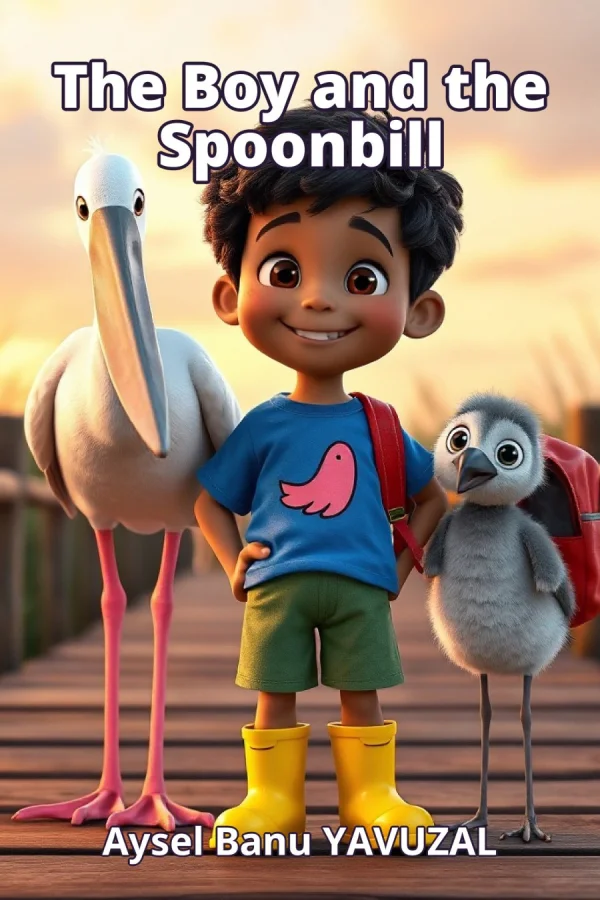
Theo pulled on his bright yellow rain boots and grabbed his red backpack. Today was wetland day! He had packed his notebook, a sharp pencil, and a big smile. His blue t-shirt had a bird printed on it, but Theo wanted to see real birds. "Ready for an adventure?" his mom asked. "Ready!" Theo said, and off they went. 1
The wetland was full of sound. Water lapped softly, and reeds whispered in the wind. Theo stood on a wooden walkway and looked out. Mud shimmered under the sun. "What lives here?" he wondered. His mom pointed across the water. "Look over there," she said. "Those white birds are spoonbills." Theo's eyes went wide. 2
Theo watched the spoonbills wade in the shallow water. Their long pink legs moved slowly and carefully. Their necks were long, and their feathers were bright white. But the strangest part was their beaks. Each beak was flat and wide at the end, like a spoon! "Why do they have spoons on their faces?" Theo asked, laughing. 3
"That's a good question," his mom said. "Let's watch and find out." Theo pulled out his notebook and pencil. He sat on the walkway and began to sketch. First he drew the long pink legs. Then the white feathers. Then the funny spoon-shaped bill with its dark tip. He wrote: Spoonbill. Beak looks like a spoon. Why? 4
One spoonbill stepped into the water. It was the mother. She was tall and calm, with a little crest of feathers on her head. Theo held his breath. The mother spoonbill lowered her bill into the water. Then she swept it from side to side. Swish, swish, swish. The water rippled around her beak. "What is she doing?" Theo whispered. 5
The mother spoonbill kept sweeping her bill through the shallow water. Her bill was open just a little. Theo leaned closer. "It looks like she's stirring soup," he said. His mom smiled. "She is stirring something," she said. "Wait and see." Theo's pencil flew across the page. He drew arrows to show the sweeping motion. Swish, swish. 6
Then the mother spoonbill lifted her head. In her bill, something small and silvery wiggled. A tiny fish! Theo gasped. "She caught it!" he said. The mother spoonbill tilted her head back and swallowed the fish. Theo wrote in his notebook: The spoon sweeps the water. The fish cannot escape. The beak catches food! This is an adaptation. 7
A smaller bird waddled out of the reeds. It was a young spoonbill. Its feathers were soft and grey-white, like cotton. Its bill was shorter, but still shaped like a little spoon. The young bird had big round eyes. It stood a bit clumsily, with its thin legs close together. "That must be her chick," Theo whispered. 8
The young spoonbill was hungry. It followed its mother to the water's edge. It lowered its short bill, but it didn't sweep. It just poked. Splash! Nothing. Poke, poke. Splash! Still nothing. The young bird shook its head. It looked at its mother. Then it tried again. Theo giggled softly. "It's still learning," he said. 9
The mother spoonbill didn't scold. She just swept her bill again, slow and steady. Swish, swish. The young spoonbill watched. Then it tried to copy her. It swept its little bill from side to side. Swish! It was a bit wobbly, but it was sweeping! Theo drew quick lines to show the motion. "It's learning to use its spoon!" he whispered. 10
Theo turned the page and drew a big picture. He drew the mother spoonbill with her bill in the water. He drew little fish swimming near. He drew the young spoonbill trying to sweep. Then he wrote: The spoonbill's beak is flat and wide. It sweeps the water to catch food. The chick learns by watching. This is how spoonbills survive. 11
Theo thought about other animals. He wrote: Every animal has its own clever way. A giraffe has a long neck to reach leaves. A duck has webbed feet for swimming. A rabbit has strong legs for hopping. Different adaptations help animals survive in their homes. His pencil was getting shorter, but his ideas were growing bigger. 12
The young spoonbill finally caught something! It lifted its short bill, and a tiny fish wiggled in the spoon. The young bird swallowed it quickly. Then it flapped its wings and wobbled happily. The mother spoonbill gave a soft, gentle call. Theo smiled so wide that his gap tooth showed. "Good job, little spoonbill!" he whispered. 13
The sun began to sink, painting the wetland orange and pink. The spoonbills waded to the reeds to rest. Theo closed his notebook and hugged it to his chest. "Did you learn something today?" his mom asked. Theo nodded. "Their spoons are like tools," he said. "Every animal has a special tool to help it live." 14
On the way home, Theo looked at his drawings. He had drawn the sweeping bill, the little fish, and the young bird learning. He turned to his mom. "I'm glad spoonbills have spoons," he said. "And I'm glad I have a notebook to write about them." His mom smiled. "We all have our own ways to explore the world," she said. 15
That night, Theo taped his best drawing above his bed. It showed the mother spoonbill sweeping her bill through the water, and the young one copying her. Under it, he wrote: Different adaptations help animals survive. He looked at it and smiled. Tomorrow, he would draw more animals. But today, the spoonbills were his favorite.
This section is a preview taken from the book (about 943 words). To continue, read the book or download the PDF.
Book Details
- Book
- The Boy and the Spoonbill
- Author
- Aysel Banu YAVUZAL
- Category
- Children's Fairy Tales
- Language
- English
- Format
- PDF · 10.7 MB
- Pages
- 18
- Words
- about 944
- Published
- masalizle.com
- Access
- Free to read and download; for personal use only, all rights belong to the author.
Frequently Asked Questions
Is the PDF of The Boy and the Spoonbill free?
Yes. The Boy and the Spoonbill can be read and downloaded for free on this site; no sign-up or payment is required.
How many pages is The Boy and the Spoonbill?
The Boy and the Spoonbill has 18 pages and about 944 words.
Which devices can I read The Boy and the Spoonbill on?
It is a PDF; you can read it in your browser on a phone, tablet or computer, or download it and open it offline.
Who is the author of The Boy and the Spoonbill?
The Boy and the Spoonbill was written by Aysel Banu YAVUZAL; it is listed in the Children's Fairy Tales category.