The Boy and the Sea Urchin
Aysel Banu YAVUZAL
- Category Children's Fairy Tales
- Format PDF
- Size 11.2 MB
- Views 1
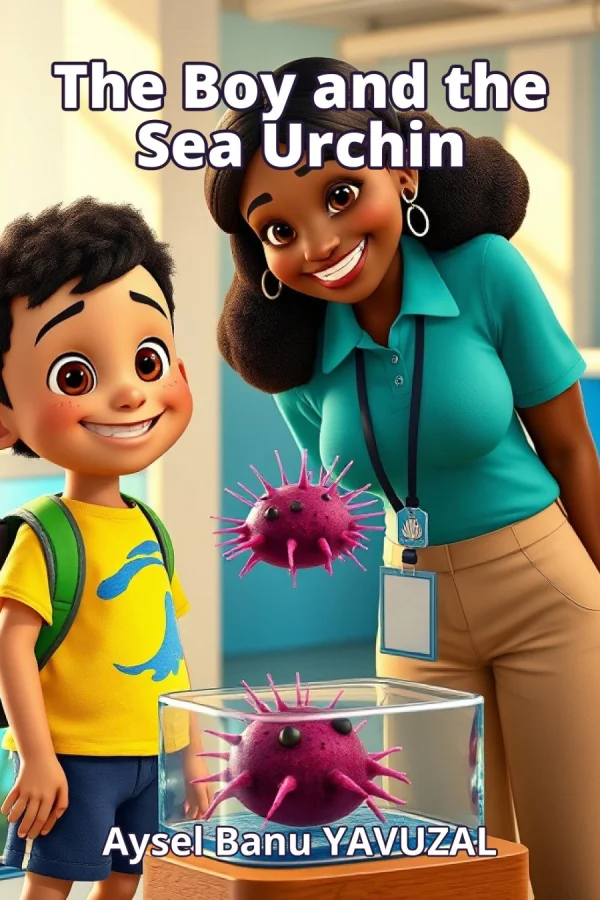
Leo arrives at the Sunny Bay Marine Center with a small green backpack and a head full of questions about sharks, sea stars and the ocean. Marina, the marine educator, welcomes him and leads him first to the smallest of the ocean's helpers: a purple-red sea urchin named Spike, who lives in a touch tank with clear water, green seaweed and a smooth rock. Leo touches Spike's soft spines, watches him glide on his tube feet and learns that seaweed is the urchin's favourite food.
As the visit continues, Marina explains why seaweed can grow too fast and how sea urchins keep it in check, acting like spiky gardeners. She shows Leo a picture of a kelp forest and describes the circle of life that links seaweed, sea urchins and sea otters. Leo meets a sea star, a crab and a small green turtle, and begins to understand that every creature has a job and that an ecosystem is a team where everyone helps everyone else. Inspired, he goes home, builds a clay model of the ocean scene and brings it back to the center to explain the balance of nature to visitors.
The story introduces young readers to marine ecology through a child's curiosity rather than through lectures. It suits children in the early primary years, as well as parents and teachers looking for a gentle way to talk about food chains, habitats and the idea that even small creatures matter. Leo's model and his proud return to the center show how a question asked at the right moment can turn into understanding worth sharing.
Read the Book
If the PDF does not appear, open it in a new tab.
A Chapter from the Book
The Boy and the Sea Urchin - Author : Aysel Banu YAVUZAL
Leo bounced through the doors of the Sunny Bay Marine Center with his small green backpack and a million questions. His yellow t-shirt with the blue wave print seemed to dance in the sunlight. "Where are all the animals?" he asked, his big dark brown eyes wide. "Can I touch a shark? Do sea stars really have eyes on their arms?" 1
Marina, the marine educator, welcomed him with a warm, crinkly smile. Her teal polo shirt had a tiny fish logo, and her shell-shaped badge jingled as she walked. "Hello, Leo! I'm Marina. Let's start with our smallest ocean helpers." Leo's gap-toothed smile grew even bigger. "Smallest? Like baby fish?" he asked, hopping beside her. 2
Marina led Leo past a tank of shimmering silver fish. "First, let's meet a creature that wears a spiky coat." She stopped at a small glass touch tank filled with clear water, green seaweed, and a smooth rock. "This is Spike," she said. Leo pressed his nose to the glass. Inside sat a round purple-red ball with long, thin spines in shades of violet and pink. 3
"Wow!" Leo whispered. "He looks like a tiny pincushion with legs." Spike's spines wiggled slowly, and his tiny dark eyes seemed to twinkle. "Can I touch him?" Leo asked. Marina nodded. "Gently, with two fingers. His spines are soft right now." Leo reached in and felt the spines tickle his fingertips like tiny feathers. "He's so cool!" 4
"What does Spike eat?" Leo asked, watching the sea urchin glide slowly along the rock using his tiny tube feet. Marina pointed to the seaweed. "Seaweed is his favorite food. He munches on it all day long." Leo giggled. "Like a salad bar!" Marina laughed. "Exactly! And he helps keep this tank clean by eating the extra seaweed that grows too fast." 5
"Why does seaweed grow too fast?" Leo wondered. Marina explained, "In the ocean, if there are too many sea urchins, they eat all the seaweed. But if there are too few, seaweed can cover everything and block sunlight for other creatures. Sea urchins help keep the balance just right." Leo's eyes grew wide. "So Spike is like a gardener?" "A very spiky gardener!" Marina said. 6
Marina showed Leo a picture of a kelp forest. "Sea urchins eat seaweed, and sea otters eat sea urchins. It's a circle of life. Every animal has a job." Leo thought hard. "So if one animal disappears, the whole circle gets wobbly?" Marina nodded. "That's called an ecosystem. It's like a big team where everyone helps everyone else." 7
"I want to see more!" Leo said. Marina led him to a tank with a sea star, a crab, and a small green turtle. "Each one has a role," she said. "The crab cleans the sand, the sea star eats mussels, and the turtle nibbles sea grass." Leo watched the crab scuttle sideways. "They're all helping each other!" he shouted. "Like a big ocean family!" 8
Leo returned to Spike's tank. "Spike, you're a hero!" he said. The sea urchin wiggled his spines as if to say thank you. "I wish everyone knew about sea urchins," Leo told Marina. "They're small but super important." Marina smiled. "That's a wonderful idea, Leo. How could we teach others?" Leo tapped his chin. "I could build a model!" 9
At home, Leo gathered boxes, clay, and paint. He made a blue ocean scene with a sandy bottom. He shaped a purple sea urchin from clay and stuck in thin spines of violet and pink. He added a kelp forest, a sea otter, and a crab. His little sister watched. "What's that spiky thing?" she asked. "That's Spike!" Leo said. "He keeps the ocean clean." 10
The next day, Leo brought his model to the marine center. Marina clapped her hands. "This is fantastic!" she said. Leo placed it on a table and explained each part. "Here's Spike eating seaweed. If he eats too much, the kelp disappears. If he eats too little, the kelp gets too thick. It's all about balance!" Visitors gathered to listen. 11
A little girl asked, "Why is the sea otter there?" Leo pointed to the otter. "Because sea otters eat sea urchins! So they help keep the urchin numbers just right. And the crab cleans the sand, and the turtle eats sea grass. Everyone works together." Marina beamed. "You've built a perfect ecosystem model, Leo. You're a real marine educator now!" 12
Leo's model stayed at the marine center for a whole month. Children and grown-ups stopped to look. Some said, "I never knew sea urchins were so important!" Leo felt proud. He visited Spike often. "You're my favorite spiky teacher," he told the sea urchin. Spike wiggled his spines, and Leo was sure he was smiling. 13
On the last day of summer, Marina gave Leo a small shellshaped badge. "For teaching everyone about balance," she said. Leo wore it on his green backpack. "I learned that every creature, even a tiny urchin, has a job in nature," he said. "And when we care for all of them, the whole ocean stays healthy." 14
Leo walked home along the beach, watching the waves roll in. He thought about Spike and all the ocean helpers. "I'm going to keep learning," he told his mom. "Maybe I'll be a marine scientist someday." His mom smiled. "I think Spike would love that." Leo grinned his gap-toothed smile and skipped all the way home.
This section is a preview taken from the book (about 922 words). To continue, read the book or download the PDF.
Book Details
- Book
- The Boy and the Sea Urchin
- Author
- Aysel Banu YAVUZAL
- Category
- Children's Fairy Tales
- Language
- English
- Format
- PDF · 11.2 MB
- Pages
- 18
- Words
- about 983
- Published
- masalizle.com
- Access
- Free to read and download; for personal use only, all rights belong to the author.
Frequently Asked Questions
Is the PDF of The Boy and the Sea Urchin free?
Yes. The Boy and the Sea Urchin can be read and downloaded for free on this site; no sign-up or payment is required.
How many pages is The Boy and the Sea Urchin?
The Boy and the Sea Urchin has 18 pages and about 983 words.
Which devices can I read The Boy and the Sea Urchin on?
It is a PDF; you can read it in your browser on a phone, tablet or computer, or download it and open it offline.
Who is the author of The Boy and the Sea Urchin?
The Boy and the Sea Urchin was written by Aysel Banu YAVUZAL; it is listed in the Children's Fairy Tales category.