The Boy and the Ocean Friends
Aysel Banu YAVUZAL
- Category Children's Fairy Tales
- Format PDF
- Size 10.7 MB
- Views 1
Leo is a boy who loves the ocean more than anything. With his notebook always at hand, he spends his afternoons drawing sea animals and dreaming of the deep blue water. When his class visits the aquarium, a guide explains the ocean food web, and Leo is fascinated to learn how every sea creature is connected. He discovers that tiny plants called plankton feed the little fish, the little fish feed the big fish, and the big fish help keep the ocean balanced. This inspires Leo to create a food-web exhibit for the school science fair, using colored paper, string, and his own drawings to show how even the smallest creatures play a big part.
Through Leo's project, readers learn about the interconnectedness of marine life and the importance of every organism in an ecosystem. The story emphasizes curiosity, careful observation, and the idea that everyone has a role to play. Leo's enthusiasm is contagious, and his relationship with his little sister adds a warm family touch.
This book is perfect for young readers who are curious about nature and the sea. It combines a gentle story with basic ecological concepts, making it an enjoyable and educational read for children and a useful resource for parents and teachers.
Read the Book
If the PDF does not appear, open it in a new tab.
A Chapter from the Book
The Boy and the Ocean Friends - Author : Aysel Banu YAVUZAL
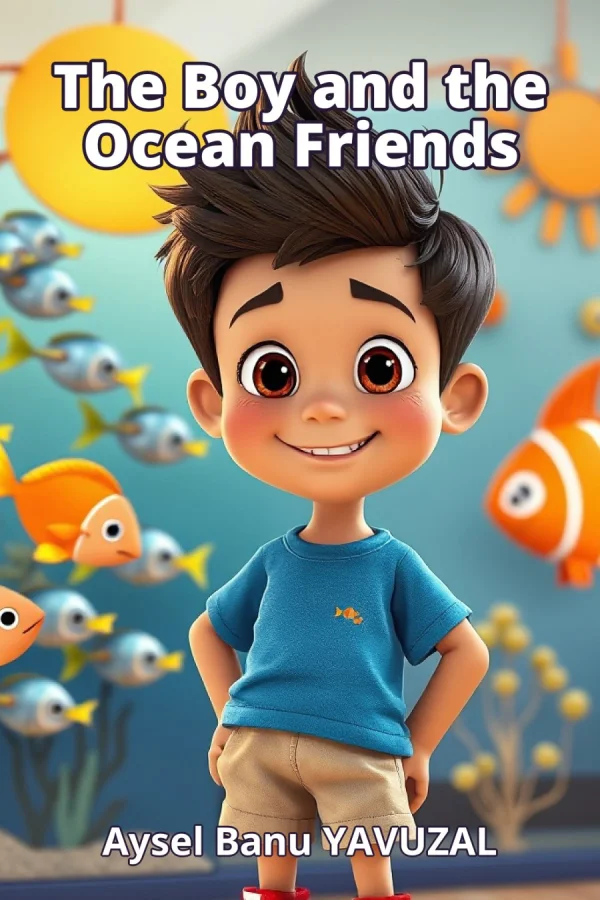
Leo loved the ocean more than anything. He had short wavy brown hair that stuck up at the front, and his round hazel eyes sparkled when he talked about the sea. Every afternoon, he sat by the window with his notebook, drawing sea animals and dreaming of the deep blue water. His blue T-shirt had a little orange fish on it, and he wore it almost every day. 1
One sunny morning, Leo's class took a trip to the aquarium. He pressed his nose against the glass and watched a school of little fish swim by. Their silver-blue bodies flashed like coins, and their yellow tails wiggled quickly. "Wow!" Leo whispered. "They move together like one big fish!" He pulled the pencil from behind his ear and started sketching. 2
At the aquarium, a guide told the class about the ocean food web. "Every sea animal is connected," she said. "Tiny plants feed the little fish. Little fish feed the big fish. Every connection matters!" Leo's eyes grew wide. He thought about the little fish and the big fish and how they all depended on each other. He wanted to learn more. 3
Back home, Leo read every ocean book he could find. He learned that tiny plants, called plankton, float near the sunlight and make their own food. They have little leaf-like arms and glow softly in the water. "They're so small," Leo said, "but they feed the whole ocean!" He drew them as cheerful little dots with smiling faces. 4
Leo learned that little fish, like the ones he saw at the aquarium, eat the tiny plants. Their silver-blue bodies dart through the water, and their yellow tails flash as they swim in a small school. "They're quick and friendly," Leo said. He drew them with big round black eyes and tiny open mouths, as if they were laughing. 5
Then Leo learned about the big fish. It was deep orange with white stripes and a tall dorsal fin. It had a wide, calm mouth and smooth, shiny scales. "It eats the little fish," Leo read. "That keeps the little fish from eating all the tiny plants." Leo drew the big fish gliding through the open blue water, looking gentle and steady. 6
Leo began to see the connections. The tiny plants feed the little fish. The little fish feed the big fish. And when the big fish swims, it helps keep the ocean balanced. "It's like a big team," Leo said. "Everyone has a job." He drew arrows connecting the plants, the little fish, and the big fish in his notebook. 7
Leo wanted to share what he learned. "I could make a foodweb exhibit for the school science fair!" he thought. He asked his teacher, who smiled and said, "What a wonderful idea, Leo!" That night, Leo planned his exhibit. He would use colored paper, string, and lots of drawings. He could hardly wait to start. 8
The next day, Leo got to work. He cut out tiny plants with little leaf-like arms and drew smiling faces on them. He made a school of little fish with silver-blue bodies and yellow tails. Then he cut out a big orange fish with white stripes and a tall dorsal fin. He connected them all with bright yarn to show the food web. 9
Leo's little sister came to see. "What are you making?" she asked. "It's an underwater food web," Leo said. "See? The tiny plants feed the little fish, and the little fish feed the big fish. Every connection matters!" His sister clapped her hands. "It looks like a big happy family!" she said. Leo smiled. "That's exactly what it is." 10
On the day of the science fair, Leo set up his exhibit. He hung the tiny plants near a yellow paper sun. The little fish swam in a blue paper sea. The big fish glided above them. Strings of yarn connected them all. Leo stood proudly beside his work, his pencil behind his ear and his fish-print shirt bright and clean. 11
Children gathered around Leo's exhibit. "Wow!" said a girl with braids. "I didn't know little fish helped big fish!" Another boy pointed at the tiny plants. "These are so small, but they feed everyone!" Leo explained each connection. "Every animal depends on another," he said. "Even the smallest creatures play a big part." 12
Leo's teacher smiled. "You've shown us how ecosystems depend on connections," she said. Leo felt warm inside. He looked at his exhibit and thought about the real ocean. Somewhere out there, tiny plants were floating in the sunlight, little fish were nibbling them, and big fish were swimming calmly. All connected. All important. 13
That night, Leo lay in bed and thought about the ocean. He imagined the tiny plants glowing, the little fish darting, and the big fish gliding. He smiled, knowing that even small creatures play a big part in keeping the ocean happy and healthy. "Connections matter," he whispered. "Just like friends." 14
The next morning, Leo's friends asked if they could help him make more exhibits. "Let's make one for the whole school!" said the girl with braids. Leo's round hazel eyes sparkled. "Yes!" he said. "We can show everyone how the ocean is one big team." They all cheered. Leo's heart felt full, like the ocean itself.
This section is a preview taken from the book (about 902 words). To continue, read the book or download the PDF.
Book Details
- Book
- The Boy and the Ocean Friends
- Author
- Aysel Banu YAVUZAL
- Category
- Children's Fairy Tales
- Language
- English
- Format
- PDF · 10.7 MB
- Pages
- 18
- Words
- about 959
- Published
- masalizle.com
- Access
- Free to read and download; for personal use only, all rights belong to the author.
Frequently Asked Questions
Is the PDF of The Boy and the Ocean Friends free?
Yes. The Boy and the Ocean Friends can be read and downloaded for free on this site; no sign-up or payment is required.
How many pages is The Boy and the Ocean Friends?
The Boy and the Ocean Friends has 18 pages and about 959 words.
Which devices can I read The Boy and the Ocean Friends on?
It is a PDF; you can read it in your browser on a phone, tablet or computer, or download it and open it offline.
Who is the author of The Boy and the Ocean Friends?
The Boy and the Ocean Friends was written by Aysel Banu YAVUZAL; it is listed in the Children's Fairy Tales category.