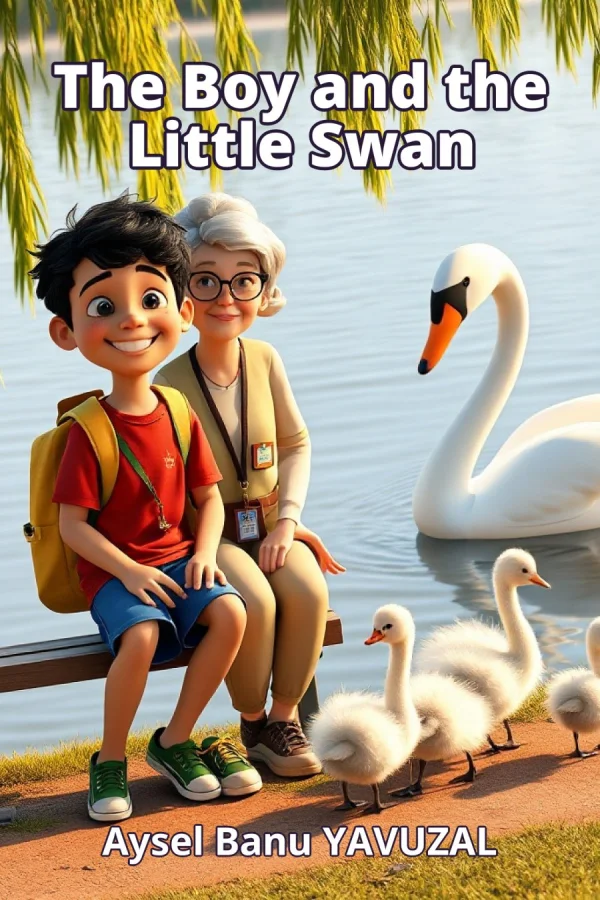
The Boy and the Little Swan
Aysel Banu YAVUZAL
- Category Children's Fairy Tales
- Format PDF
- Size 11.8 MB
- Views 2
Every Saturday, a boy with a yellow canvas backpack walks to the park and sits on the same bench beside the lake, watching a mother swan and her four grey cygnets. When the park ranger, Mrs. Hale, explains that swans are shy and easily frightened, the boy begins to keep a quiet, respectful distance and records what he learns in his notebook: watch quietly, never chase. Over the weeks he returns again and again, and the swan family comes to trust his calm presence.
When a visiting family runs at the water with a bag of bread, the boy finds the courage to speak up. He shows them his drawings and explains, politely, why the swans need space and why bread harms them. His quiet confidence changes how the visitors behave, and it gives him an idea: with Mrs. Hale's help, he plants a sign beside the bench asking everyone to watch quietly and never chase or feed the birds.
Through the summer and into autumn, the boy watches the cygnets grow from fuzzy grey balls of down into strong white swans, and he learns that kindness can be a quiet kind of magic. This gentle story is written for young children and for the adults who read with them. It offers a simple, practical lesson about respecting wildlife, speaking up for what is right, and understanding that animals thrive when people give them room to live undisturbed.
Read the Book
If the PDF does not appear, open it in a new tab.
A Chapter from the Book
The Boy and the Little Swan - Author : Aysel Banu YAVUZAL
Every Saturday, the boy walked to the park with his yellow canvas backpack bouncing behind him. He loved the big lake at the middle of the park, where ducks paddled and willow trees dipped their branches in the water. Today the lake sparkled like a handful of coins. The boy sat on a bench and waited to see who would swim by. 1
A mother swan glided out from the reeds, her white feathers bright in the sun. Her long curved neck moved like a gentle question mark, and her orange beak had a neat black base. Behind her came four tiny cygnets, fuzzy grey balls of down. The boy leaned forward, smiling. He opened his small notebook and began to draw. 2
A soft voice spoke beside him. "You are watching very politely," said Mrs. Hale, the park ranger, in her green vest and round glasses. Silver hair curled in a neat bun above her kind, wrinkled smile. She pointed to a blue band on the mother swan's leg. "That lady is Swan Number Seven. She comes here every spring." 3
"Why does she keep her babies so close?" the boy asked. Mrs. Hale knelt beside the bench. "Swans are shy and careful," she said. "When people crowd them or chase them, they get scared. Scared swans splash and hiss, and sometimes they swim away from their young. A quiet, respectful distance keeps everybody safe." 4
The boy nodded slowly. He watched the cygnets paddle in a neat grey line, bumping softly into each other. One flapped its tiny wings and almost tipped over. The mother swan turned her head and nudged it gently with her beak. The boy wrote in his notebook: WATCH QUIETLY. NEVER CHASE. He drew a small heart beside the words. 5
Weeks passed. The boy came back each Saturday, always sitting on the same bench. The cygnets grew taller and stronger, their grey down turning smoother. They practiced flapping and splashing near the reeds while their mother kept one dark eye on the shore. "They remember you," Mrs. Hale said. "You never frighten them." 6
One sunny morning, a family arrived with a big bag of bread. The children ran to the water's edge, shouting and waving. The mother swan pulled her cygnets back into the reeds, her wings lifted and her neck stretched tall. The boy's heart thumped. He stood up and walked over, holding his notebook open. 7
"Excuse me," he said politely. "The swans get scared when we run at them. If we sit quietly on the grass, they will swim close to us all by themselves." The family looked at his notebook drawings. The father nodded. "You are right," he said. "We should not feed them bread either. It makes them sick." 8
The family sat down on the grass, and the boy sat with them. In a few minutes, the mother swan glided out of the reeds again, her cygnets trailing behind her like little grey boats. Everyone watched without a sound. The smallest cygnet paddled right past the boy's green sneakers, so close he could see its tiny beak. 9
After that, the boy had an idea. He asked Mrs. Hale if he could make a sign for the lake path. She clapped her hands. "A wonderful idea!" she said. The boy wrote big, careful letters: SWAN FAMILIES LIVE HERE. PLEASE WATCH QUIETLY. PLEASE DO NOT CHASE OR FEED. He drew a mother swan and four fluffy babies. 10
Mrs. Hale helped him plant the sign beside the bench. People stopped to read it as they walked by. Some asked questions, and the boy answered them with a bright, open smile. "Swans are shy," he explained. "When we give them space, they stay calm and their babies grow up safe." Visitors nodded and moved quietly to the grass. 11
All summer, the lake grew busier and happier. Children sat still as stones, watching cygnets practice their first short flights. Parents whispered instead of shouting. The mother swan swam wherever she liked, her four babies now tall and strong. Mrs. Hale told the boy, "You changed this whole park. Kindness is a quiet kind of magic." 12
The boy smiled and opened his notebook to a fresh page. He drew the lake, the reeds, the mother swan, and four elegant young swans gliding behind her. Underneath, he wrote a new line: RESPECTFUL DISTANCE KEEPS WILDLIFE HAPPY. He tucked the notebook back into his yellow backpack, ready for the next Saturday. 13
Autumn came, and the cygnets' grey down turned white like their mother's. They stretched their long necks and spread broad wings over the water. The boy watched from his bench, feeling proud and peaceful. He knew that next spring there would be new little grey cygnets, and he would be there to welcome them. 14
One afternoon, a little girl asked him, "Why do you sit so far away?" The boy smiled. "Because they are not toys," he said gently. "They are wild and shy, and they need space to be happy." The girl thought about it, then sat down beside him, quiet as a mouse. Together they watched the swans glide by. 15
The sun set gold across the lake, and the swan family drifted toward the reeds. The boy pulled on his yellow backpack and waved goodbye. On the path, visitors read his sign and smiled. He had learned that watching quietly is a kind of love. The lake, the swans, and everyone who visited were happier because of it.
This section is a preview taken from the book (about 933 words). To continue, read the book or download the PDF.
Book Details
- Book
- The Boy and the Little Swan
- Author
- Aysel Banu YAVUZAL
- Category
- Children's Fairy Tales
- Language
- English
- Format
- PDF · 11.8 MB
- Pages
- 18
- Words
- about 934
- Published
- masalizle.com
- Access
- Free to read and download; for personal use only, all rights belong to the author.
Frequently Asked Questions
Is the PDF of The Boy and the Little Swan free?
Yes. The Boy and the Little Swan can be read and downloaded for free on this site; no sign-up or payment is required.
How many pages is The Boy and the Little Swan?
The Boy and the Little Swan has 18 pages and about 934 words.
Which devices can I read The Boy and the Little Swan on?
It is a PDF; you can read it in your browser on a phone, tablet or computer, or download it and open it offline.
Who is the author of The Boy and the Little Swan?
The Boy and the Little Swan was written by Aysel Banu YAVUZAL; it is listed in the Children's Fairy Tales category.