The Boy and the Little Crab
Aysel Banu YAVUZAL
- Category Children's Fairy Tales
- Format PDF
- Size 10.7 MB
- Views 1
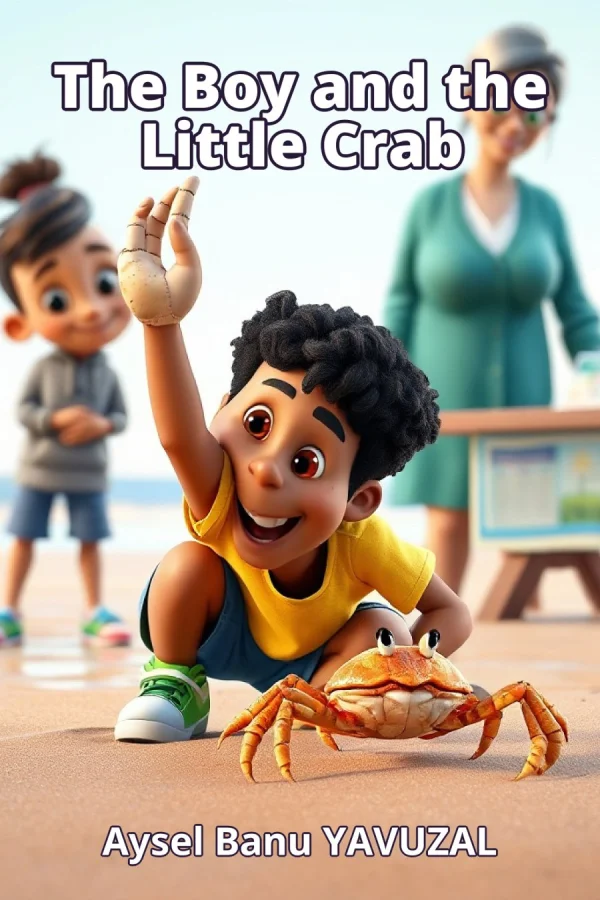
On a bright Saturday morning, a curious boy heads down to the beach with his red bucket hat, a small notebook and a pencil, hoping to find something amazing for his school science display. Near the water's edge he spots a little crab with a sandy-orange shell, one enormous pale claw and one tiny one. When the crab raises its giant claw and waves it slowly, the boy is fascinated. He sketches the crab, waits patiently by its burrow and watches as it waves at him and at other crabs, slowly realizing that the big claw is a way of talking.
Back at school, his teacher recognizes the creature as a fiddler crab and encourages him to build his project around it. The boy visits the library, fills his notebook with facts about how male fiddler crabs use their large claw to communicate, and creates a cardboard crab display complete with real sand, a paper-cup burrow and clear labels. At the science fair he explains to his classmates that the big claw is for communicating rather than fighting, and together they wave their arms like crabs, discovering that animals have their own ways of saying hello and stay away.
The story shows young readers how careful observation and patience can turn a simple moment on the beach into real scientific discovery. It introduces basic facts about fiddler crabs and animal communication while celebrating curiosity, note-taking and sharing what you learn. The book suits early primary school children, especially those preparing their first science projects or learning to look closely at the natural world around them.
Read the Book
If the PDF does not appear, open it in a new tab.
A Chapter from the Book
The Boy and the Little Crab - Author : Aysel Banu YAVUZAL
On a bright Saturday morning, the boy raced down to the beach with his red bucket hat pulled low. He loved the smell of salt and the sound of waves. In his pocket, a small notebook and pencil waited for new facts. Today, he hoped to find something amazing for his science display. The sand was warm under his green sneakers as he searched the shore. 1
Near the water's edge, something tiny moved. The boy crouched low, his dark brown eyes wide. A little crab scuttled sideways across the wet sand. It had a sandy-orange shell and one enormous pale claw! The other claw was tiny. The boy pulled out his notebook. 'Hello, little crab,' he whispered. 'What are you?' 2
The crab stopped and raised its giant claw high. It waved the claw slowly, like a tiny flag. The boy watched, fascinated. 'Why are you waving?' he wondered aloud. He sketched the crab in his notebook, noting the big claw and the small one. This was no ordinary crab. It seemed to be trying to tell him something. 3
A wave rolled in, and the crab scurried to its burrow. The boy waited patiently. Soon, the crab popped out again, its stalked eyes peeking above the sand. It waved its big claw once more. The boy waved back with his hand. 'Are you saying hello?' he asked. The crab waved faster, as if excited. The boy laughed. This was going to be a great science display! 4
The boy spent the whole morning watching the crab. He saw it wave its big claw at another crab nearby. That crab waved back, then hurried away. 'Maybe the big claw is for talking,' the boy thought. He wrote in his notebook: 'Fiddler crab waves big claw to communicate.' His freckled nose crinkled with a smile. Science was everywhere! 5
When the tide came in, the boy headed home. He couldn't stop thinking about the little crab. At school on Monday, he told his teacher, 'I saw a crab with one huge claw! It waved at me!' His teacher, in her teal cardigan, smiled warmly. 'That sounds like a fiddler crab,' she said. 'Why don't you make your science display about it?' The boy's eyes lit up. 6
That afternoon, the boy went to the library. He read books about fiddler crabs. He learned that males have one big claw and one small feeding claw. The big claw is used to communicate! They wave it to say hello, to attract a mate, or to warn others to stay away. 'Fascinating!' the boy whispered. He wrote fact after fact in his notebook. 7
At home, the boy started building his display. He painted a big cardboard crab with one enormous claw. He added real sand and a little burrow made from a paper cup. He wrote labels: 'Big claw waves to talk!' and 'Small claw feeds.' His mom helped him hang a poster. The boy practiced waving his own big claw, just like the crab. 8
On the day of the science fair, the boy set up his display on a table. His classmates gathered around. The boy wore his yellow t-shirt and red bucket hat for luck. He took a deep breath. 'This is a fiddler crab,' he began. 'It has one big claw and one small claw. The big claw is for communicating, not fighting.' 9
The boy demonstrated how the crab waves its claw. 'When a crab waves its big claw, it might be saying, "Hello, I'm here!" or "Stay away!"' he explained. His classmates waved their hands like claws. Everyone laughed. The teacher, standing beside the display, gestured proudly. 'Isn't it fascinating how animals communicate?' she said. The boy nodded, his gaptoothed smile wide. 10
A girl asked, 'How do they know what the wave means?' The boy thought for a moment. 'They probably learn from other crabs,' he said. 'Just like we learn words.' He showed them his notebook sketches. 'I watched this crab for a whole morning,' he said. 'It waved at me, and I waved back!' The class was amazed. The boy felt proud of his research. 11
Then the boy had an idea. 'Let's all wave our big claws like fiddler crabs!' he said. The class raised their arms and waved. The teacher joined in. 'What are you saying?' she asked. 'We're saying hello!' the children shouted. The boy beamed. His science display had taught everyone something new and fun. The little crab had been a great teacher. 12
At the end of the day, the teacher announced, 'This display is wonderful! You explained how crabs communicate in such a clear way.' The boy's cheeks turned pink with happiness. He looked at his cardboard crab. He remembered the little crab on the beach, waving its big claw. He had turned a simple moment into something special. 13
That evening, the boy told his family all about the science fair. 'Everyone loved the crab facts!' he said. His mom hugged him. 'You worked hard,' she said. The boy smiled. He couldn't wait to visit the beach again. Maybe he would see another fiddler crab and learn even more. The world was full of fascinating creatures, just waiting to be noticed. 14
The next weekend, the boy returned to the beach. He sat quietly by the water's edge, notebook in hand. Soon, a little crab appeared. It raised its big claw and waved. The boy waved back. 'Hello, friend,' he said softly. He knew that animals communicate in amazing ways. All you have to do is watch and listen.
This section is a preview taken from the book (about 942 words). To continue, read the book or download the PDF.
Book Details
- Book
- The Boy and the Little Crab
- Author
- Aysel Banu YAVUZAL
- Category
- Children's Fairy Tales
- Language
- English
- Format
- PDF · 10.7 MB
- Pages
- 18
- Words
- about 1,007
- Published
- masalizle.com
- Access
- Free to read and download; for personal use only, all rights belong to the author.
Frequently Asked Questions
Is the PDF of The Boy and the Little Crab free?
Yes. The Boy and the Little Crab can be read and downloaded for free on this site; no sign-up or payment is required.
How many pages is The Boy and the Little Crab?
The Boy and the Little Crab has 18 pages and about 1,007 words.
Which devices can I read The Boy and the Little Crab on?
It is a PDF; you can read it in your browser on a phone, tablet or computer, or download it and open it offline.
Who is the author of The Boy and the Little Crab?
The Boy and the Little Crab was written by Aysel Banu YAVUZAL; it is listed in the Children's Fairy Tales category.