The Boy and the Little Cormorant
Aysel Banu YAVUZAL
- Category Children's Fairy Tales
- Format PDF
- Size 11.0 MB
- Views 2
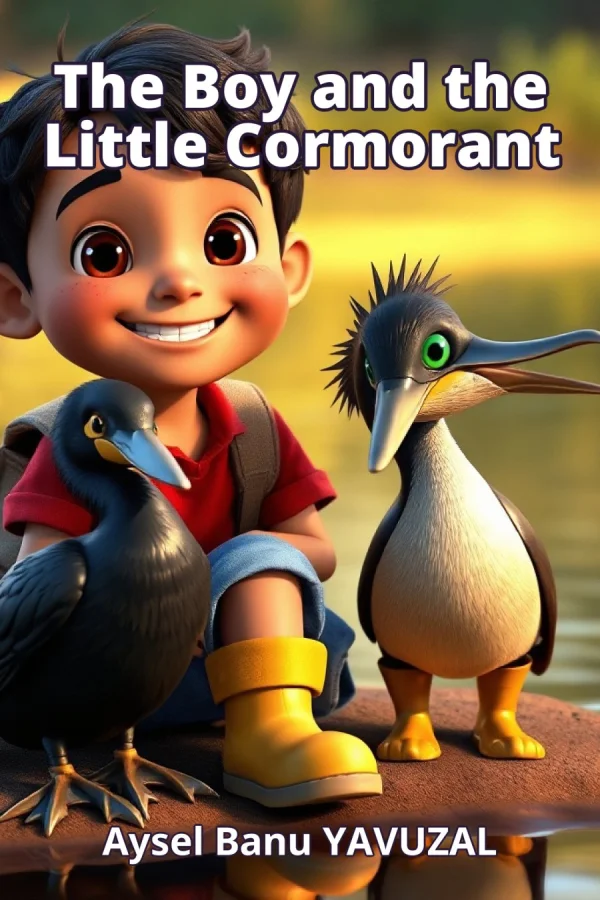
On the edge of a sleepy pond, a curious boy named Leo spends his mornings watching the birds and sketching in his canvas satchel. One day a sleek black cormorant surfaces beside him, a silver fish in its hooked beak, and Leo is captivated. From that moment he returns to the pond again and again, filling his sketchbook with drawings and notes about the bird's long neck, glossy waterproof feathers, webbed feet and bright emerald eyes.
Eager to understand how the cormorant lives so easily in the water, Leo reads books at the library and asks the old fisherman, Mr. Chen, about the bird's special adaptations. He learns how the feathers trap air and shed water, how the feet paddle like oars, and how the eyes see clearly beneath the surface. Leo tests what he has learned by watching the cormorant preen, dive and ride out a windy, choppy day, and he decides to turn his observations into a fun guide for other children.
This gentle story follows a boy who turns everyday curiosity into patient observation and careful research. Through Leo's sketchbook and his first nervous presentation to his classmates, young readers see how watching closely, asking questions and sharing what you learn can build confidence and knowledge. The book is suited to early primary school children and to anyone who enjoys quiet nature stories about animals, ponds and the rewards of paying attention.
Read the Book
If the PDF does not appear, open it in a new tab.
A Chapter from the Book
The Boy and the Little Cormorant - Author : Aysel Banu YAVUZAL
On the edge of the sleepy pond, a boy named Leo sat with his boots dangling in the water. He loved the quiet plip-plop of drips and the smell of wet mud. Every morning, he came to watch the birds. He had short curly black hair that bounced when he ran, and a red shirt that always got splashed. His canvas satchel held a sketchbook and pencils, ready for anything new. 1
One morning, a sleek black bird popped up from the water. It had glossy feathers with a bronze-green sheen, like secret colors hiding in the sun. Its long hooked beak held a wriggling silver fish. Bright emerald-green eyes blinked at Leo. The little cormorant tilted its head, as if to say, 'Watch this!' Then it dove down with a splash. 2
Leo's eyes went wide. 'Wow!' he whispered. He grabbed his sketchbook and drew the bird's shape: the long neck, the low body, the little yellow patch under its chin. He noticed webbed feet with strong claws paddling fast. 'You're built for swimming,' he said. The cormorant bobbed up again, and Leo grinned. He decided to follow it and learn everything it did. 3
Every day after that, Leo returned to the pond. He watched the cormorant dive deep and stay under for a long time. 'How do you hold your breath?' he wondered. The bird's sleek feathers lay flat, so water slid right off. Its strong feet pushed like paddles, and its clear eyes saw fish in the murky water. Leo drew each part and wrote notes in his sketchbook. 4
One afternoon, the cormorant swam close to shore. Leo crouched low and stayed very still. 'Hello, little fisher,' he said softly. The bird shook its head and flapped its wings. Leo noticed how the feathers trapped a layer of air, keeping the bird warm and light. He sketched the tiny yellow throat patch that helped the bird make soft sounds. 'You're full of surprises,' Leo said. 5
The cormorant dove again, and Leo counted the seconds. One, two, three... almost twenty! When it surfaced, it held a tiny silver fish. Leo clapped quietly. He drew the bird's hunting pose: head low, neck stretched, then a quick snap of the hooked beak. 'You're a master fisher,' Leo said. The cormorant seemed to nod, then flipped its tail and dove once more. 6
Leo wanted to know more. He read books at the library and talked to the old fisherman, Mr. Chen. 'Cormorants have special adaptations,' Mr. Chen said. 'Their feathers are waterproof, their feet are webbed for swimming, and their eyes can see clearly underwater.' Leo wrote it all down. He drew arrows pointing to each part. 'Adaptations help animals thrive,' he whispered. That would be the title of his guide. 7
Back at the pond, Leo tested his ideas. He watched the cormorant preen its feathers with its beak, spreading oil to keep them dry. He saw how the bird's legs were set far back, perfect for paddling fast. 'Your body is a swimming machine,' Leo said. He drew a diagram of the bird's skeleton, with strong muscles for diving. The cormorant swam in circles, showing off. 8
One windy day, the water was choppy. Leo worried the little cormorant might have trouble. But the bird rode the waves easily, its low body cutting through the water. It dove and came up with a fish, then another. Leo sketched the bird in action, adding swooshes for splashes. 'You thrive even when it's rough,' he said. The cormorant shook its feathers and flapped its wings dry. 9
Leo decided to make a fun guide for other kids. He drew the cormorant on the cover, with emerald eyes and a silver fish in its beak. Inside, he wrote: 'Step one: sleek feathers for speed.' He added jokes and questions. 'Did you know a cormorant can stay underwater for almost a minute?' He drew little fish hiding behind rocks. The cormorant watched him from the water, as if reading over his shoulder. 10
When the guide was finished, Leo showed it to Mr. Chen. 'This is wonderful!' Mr. Chen said. 'You should share it with the whole class.' Leo felt nervous but excited. He stood in front of his classmates and held up his drawings. 'The little cormorant has special adaptations,' he said. 'Its feathers, feet, and eyes help it thrive in the water.' The class clapped and asked questions. 11
After school, Leo ran to the pond with his guide tucked under his arm. He sat on the bank and read it aloud to the cormorant. 'Page one: the dive. Page two: the catch.' The bird swam closer, tilting its head. When Leo finished, the cormorant dove and brought up a tiny fish, as if to say, 'Well done!' Leo laughed. 'You're the best teacher,' he said. 12
That evening, Leo added one last page to his guide. He drew the cormorant and himself, side by side on the pond bank. Under the picture, he wrote: 'We can all learn from nature. Every animal has adaptations that help it thrive.' He closed the sketchbook and hugged it. The little cormorant flapped its wings and settled on a rock, watching the sunset with him. 13
The next morning, Leo brought his guide to the library. The librarian put it on a special shelf with a sign: 'Written and illustrated by Leo.' Other kids read it and smiled. Some asked Leo to take them to see the cormorant. Leo led them to the pond, and they watched the bird dive and swim. 'Look at those emerald eyes!' one girl said. Leo nodded proudly.
This section is a preview taken from the book (about 952 words). To continue, read the book or download the PDF.
Book Details
- Book
- The Boy and the Little Cormorant
- Author
- Aysel Banu YAVUZAL
- Category
- Children's Fairy Tales
- Language
- English
- Format
- PDF · 11.0 MB
- Pages
- 18
- Words
- about 1,097
- Published
- masalizle.com
- Access
- Free to read and download; for personal use only, all rights belong to the author.
Frequently Asked Questions
Is the PDF of The Boy and the Little Cormorant free?
Yes. The Boy and the Little Cormorant can be read and downloaded for free on this site; no sign-up or payment is required.
How many pages is The Boy and the Little Cormorant?
The Boy and the Little Cormorant has 18 pages and about 1,097 words.
Which devices can I read The Boy and the Little Cormorant on?
It is a PDF; you can read it in your browser on a phone, tablet or computer, or download it and open it offline.
Who is the author of The Boy and the Little Cormorant?
The Boy and the Little Cormorant was written by Aysel Banu YAVUZAL; it is listed in the Children's Fairy Tales category.