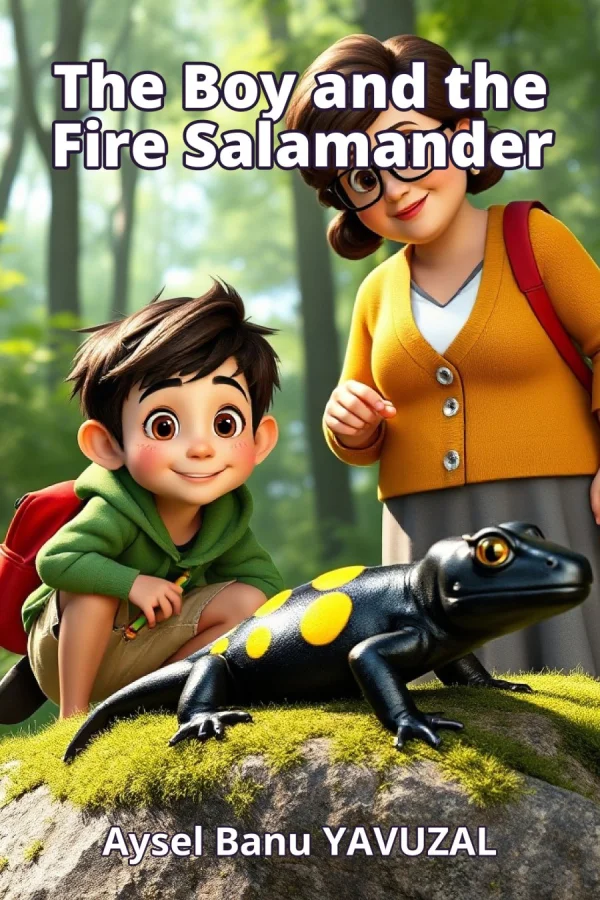
The Boy and the Fire Salamander
Aysel Banu YAVUZAL
- Category Children's Fairy Tales
- Format PDF
- Size 11.9 MB
- Views 2
Nine-year-old Leo is small, wiry and curious, with messy dark brown hair and freckles across his nose. More than anything else he loves watching wild animals, and one Saturday morning he sets off with his father into a protected forest, a red backpack on his back and a worn notebook titled MY NATURE JOURNAL under his arm. His father reminds him to stay on the trail, but Leo's hazel eyes are already searching the leaves for a shy, rare creature he once read about in a book.
After a long, patient wait on a log, something moves near a mossy rock: a fire salamander with glossy black skin, bright yellow blotches and stubby little legs. Leo crouches low, holds his breath and watches without a sound. He draws the creature carefully and records what he notices, that it lives in damp moss and old leaves, moves very slowly and never hurries. Later he finds a second, even shyer salamander near a little stream, and his father praises the careful, important work he is doing.
On Monday Leo shares his journal with his class. His teacher, Mrs. Hart, is so impressed that the children build a whole conservation exhibition, painting giant salamanders and writing signs asking people to protect rare wildlife and keep forests clean. The story shows young readers how patience, quiet observation and a simple notebook can turn curiosity into something that matters, and it gently teaches respect for shy creatures and the fragile places they live in. It suits children who love animals and nature, and any reader learning that small, careful actions can inspire others.
Read the Book
If the PDF does not appear, open it in a new tab.
A Chapter from the Book
The Boy and the Fire Salamander - Author : Aysel Banu YAVUZAL
Leo was nine years old, small and wiry, with messy dark brown hair and freckles across his nose. He loved one thing more than anything else: watching wild animals. On Saturday morning he pulled on his green hoodie, grabbed his red backpack, and tucked a pencil behind his ear. Today he was going somewhere special. Today he was going to the protected forest. 1
The protected forest was quiet and green. Tall trees stretched up and up, and soft moss covered the rocks like a blanket. Leo's father walked beside him on the path. "Stay on the trail," his father said gently. Leo nodded, but his hazel eyes were already searching the leaves. Somewhere in this forest lived a shy, rare creature he had read about in a book. 2
Leo carried a worn notebook under his arm. On the front he had written in big letters: MY NATURE JOURNAL. He opened it to a fresh page and wrote the date. Then he sat down on a log and waited. Waiting was hard, but Leo was patient. He had learned that wild animals come out when the world is still and quiet. 3
After a long time, something moved near a mossy rock. Leo held his breath. A small creature crawled out slowly: glossy black skin with bright yellow blotches, small dark eyes, and stubby little legs. It was a fire salamander! Leo's heart thumped. He crouched low, very low, and watched without making a sound. 4
The fire salamander rested on the damp moss and blinked its tiny eyes. Its yellow spots looked like sunshine on black velvet. Leo drew it carefully in his journal, his pencil moving slowly. He wrote: Bright black and yellow skin. Shiny like rain. Then the salamander crept forward, one little leg at a time, and Leo followed quietly behind. 5
Leo learned where the salamander liked to hide. It slipped under fallen leaves and stayed close to damp, cool places. It moved slowly, never in a hurry. Leo wrote: Lives in wet moss and old leaves. Moves very slowly. The salamander turned its small head, as if it knew Leo was watching, and Leo smiled. He felt like a real scientist. 6
Later, Leo found a second salamander near a little stream. This one was smaller and even shyer. It hid behind a stone and peeked out with one dark eye. Leo drew both salamanders side by side. He wrote: Rare and shy. Please protect. His father looked over his shoulder and said, "You are doing careful, important work, Leo." 7
The afternoon sun grew warm, and the forest grew busy with birds. The salamanders crept back into the shadows and hid. Leo closed his journal and held it close. He had drawn eight pages of pictures and notes. He whispered, "Goodbye, little ones. I will tell everyone about you." His father smiled and said it was time to head home. 8
On Monday morning, Leo walked into class with his journal under his arm. His teacher, Mrs. Hart, wore her mustard cardigan and silver bird pin. She had short curly black hair and kind brown eyes behind round glasses. "Leo," she said, "would you like to share something with the class?" Leo took a deep breath and nodded. 9
Leo stood in front of everyone and opened his nature journal. He showed his drawings of the fire salamanders, with their bright yellow blotches on glossy black skin. He read his notes about damp moss and fallen leaves and slow, quiet movement. His classmates leaned forward. "They are rare," Leo said, "and they need our help to stay safe." 10
Mrs. Hart clapped her hands together. "This is wonderful work, Leo!" she said. "You have shown us why rare wildlife deserves careful protection." The children began to talk all at once. They wanted to help too. Mrs. Hart smiled and said, "Then let us make something big. Let us build a conservation exhibition for the whole school." 11
Everyone worked together. Some children painted giant fire salamanders with yellow spots. Some wrote facts about protected forests and rare animals. Leo drew the biggest picture of all: the salamander on its mossy rock. His friends made signs that said PROTECT RARE WILDLIFE and PLEASE KEEP FORESTS CLEAN. The classroom filled with color and care. 12
On exhibition day, the hall was full of families and children. Mrs. Hart stood in her mustard cardigan and pointed proudly at the children's artwork. Leo walked everyone to his journal pages and explained what he had seen. People listened closely. They asked questions. Leo answered every one, his freckled face bright with excitement. 13
Leo felt proud. His small nature journal had grown into something much bigger than he ever imagined. His teacher said, "You started this, Leo. One curious boy and one notebook can inspire a whole school." Leo looked around at the bright paintings and the smiling faces. He thought about the shy salamanders hiding in the quiet forest. 14
That afternoon, Leo's friends gathered around him. "We promise to help nature too," they said. "We will keep forests clean and protect rare animals." Leo smiled and tucked his pencil behind his ear. He opened his journal to a brand-new page and wrote: My friends will help. Together we can protect the wild. 15
Leo sat by the window and looked out at the green world. He thought of the fire salamander resting on its mossy rock, safe and hidden. Rare wildlife deserves careful protection, and Leo knew now that one small boy with a notebook could make a difference. He picked up his pencil and got ready for his next adventure.
This section is a preview taken from the book (about 955 words). To continue, read the book or download the PDF.
Book Details
- Book
- The Boy and the Fire Salamander
- Author
- Aysel Banu YAVUZAL
- Category
- Children's Fairy Tales
- Language
- English
- Format
- PDF · 11.9 MB
- Pages
- 18
- Words
- about 956
- Published
- masalizle.com
- Access
- Free to read and download; for personal use only, all rights belong to the author.
Frequently Asked Questions
Is the PDF of The Boy and the Fire Salamander free?
Yes. The Boy and the Fire Salamander can be read and downloaded for free on this site; no sign-up or payment is required.
How many pages is The Boy and the Fire Salamander?
The Boy and the Fire Salamander has 18 pages and about 956 words.
Which devices can I read The Boy and the Fire Salamander on?
It is a PDF; you can read it in your browser on a phone, tablet or computer, or download it and open it offline.
Who is the author of The Boy and the Fire Salamander?
The Boy and the Fire Salamander was written by Aysel Banu YAVUZAL; it is listed in the Children's Fairy Tales category.