The Boy and the Butterfly Map
Aysel Banu YAVUZAL
- Category Children's Fairy Tales
- Format PDF
- Size 12.2 MB
- Views 1
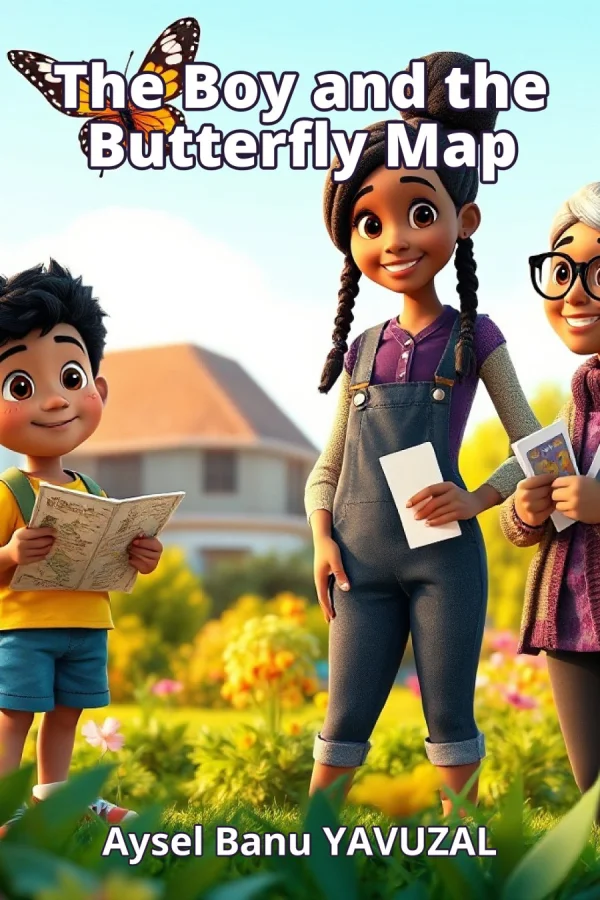
Leo is a young boy who loves butterflies more than anything. With his sketchbook and pencils, he carefully observes an orange butterfly with black veins and white spots as it visits purple and yellow flowers in his yard. He decides to create a special map of his neighborhood, marking his house with a star and drawing tiny flowers where butterflies land. The map becomes a tool for discovery and connection.
At school, Leo shares his map with his friend Maya, who is immediately intrigued. She suggests using the map to find empty spots with no flowers and plant more to attract butterflies. Their teacher, Mrs. Green, supports the idea and turns it into a class project. Together, the children plant native flower seeds around the neighborhood, learning about the needs of butterflies and the importance of patience.
As weeks pass, the seeds grow into plants with bright flowers, and soon butterflies return to the new garden. Leo and Maya watch with joy as their efforts pay off. The story highlights the value of observation, teamwork, and environmental stewardship. It teaches young readers that small actions can make a big difference and that nature rewards those who care for it. This heartwarming tale is perfect for children who love nature and want to learn how to make a positive impact on the world around them.
Read the Book
If the PDF does not appear, open it in a new tab.
A Chapter from the Book
The Boy and the Butterfly Map Aysel Banu YAVUZAL
On a sunny morning, a boy named Leo sat on his front steps with his sketchbook. He had warm light brown skin, big dark brown eyes, and a few freckles across his nose. In his green canvas satchel, he kept a pencil and a notebook. Leo loved watching butterflies more than anything else. He could sit for hours without moving, just to see where they would fly next. 1
A bright orange butterfly with black veins and white spots fluttered into Leo's yard. It landed on a purple flower and opened and closed its wings. Leo held his breath. He watched the butterfly sip nectar, then fly to a yellow flower nearby. Leo quickly drew the butterfly in his sketchbook and wrote down the flower's color. He wanted to remember every place the butterfly visited. 2
Leo decided to draw a special map of his neighborhood. He marked his house with a star and drew tiny flowers where the butterflies landed. The map showed the garden on Maple Street and the big patch of daisies near the park. Leo used a green pencil for grass and an orange pencil for butterflies. He worked all afternoon, adding more and more spots to his butterfly map. 3
The next day at school, Leo brought his map to show his friends. A girl named Maya spotted it right away. She had deep brown skin, bright hazel eyes, and two short braids. Her purple shirt had butterflies printed on it. "Wow! What's that?" she asked, pointing at the map. "It's my butterfly map," Leo said proudly. "It shows where the butterflies go." 4
Maya leaned closer and studied the map. "So these are the flowers they like best?" she asked. Leo nodded. "Yes, the orange one visits the purple flowers and the yellow ones the most." Maya's eyes grew wide. "We could use this to find empty spots!" she said. "Places with no flowers at all. Then we could plant more!" Leo smiled. He had never thought of that before. 5
Just then, their teacher, Mrs. Green, walked over. She had wavy silver-grey hair in a loose bun and kind blue eyes behind round glasses. She wore an olive-green cardigan and carried a canvas tote bag full of seed packets. "What are you two looking at?" she asked. Maya showed her the map. "Leo made this!" she said. "Can we plant flowers where there aren't any?" 6
Mrs. Green smiled warmly. "That's a wonderful idea," she said. "Native flowers give butterflies food and a place to rest. Let's make this a class project." She pulled out her seed packets and showed them to Leo and Maya. "These are seeds for flowers that grow well here. We can plant them around the neighborhood." Leo felt a happy flutter in his chest, just like a butterfly. 7
That afternoon, the whole class gathered outside with Mrs. Green. Maya held up Leo's map and pointed to a bare spot near the fence. "Here!" she said. "No flowers at all." The children carried small shovels and watering cans. Leo brought his sketchbook to mark the new spots. They dug little holes and planted seeds. Maya's red backpack bounced as she ran from spot to spot, helping everyone. 8
Each day after school, Leo checked the planting spots. He drew tiny pictures of the seeds and wrote notes about the weather. Some days it was sunny, and some days it rained. Leo learned that seeds need water and light to grow. He also learned that butterflies need flowers all season long. He added new symbols to his map: a sun for sunny spots and a raindrop for wet ones. 9
One morning, Leo saw a tiny green shoot push through the soil. "They're growing!" he shouted. He ran to tell Maya, who lived two houses away. Together they checked every spot. Some had little leaves, and some were still bare. "We just have to be patient," Maya said. Leo nodded. He knew that butterflies were patient too. They waited for flowers to bloom. 10
Weeks passed, and the plants grew taller. Buds appeared, then opened into bright flowers. One afternoon, Leo saw a familiar orange flutter. The butterfly with black veins and white spots landed right on a new purple flower. It was the same kind he had drawn in his sketchbook! Leo held his breath and watched. Then he smiled and wrote in his notebook: "Butterfly visits new garden!" 11
Maya ran over with a big grin. "It worked!" she cheered. "Our flowers brought the butterflies back!" Soon, more butterflies arrived. Some were yellow, some were white, and some were orange like the first one. The children stood quietly and watched them flutter from flower to flower. Mrs. Green joined them and said, "You see? Watching closely helped you protect them." 12
Leo looked at his map. It had changed a lot since the first day. Now there were new flower symbols everywhere, and little butterfly marks next to them. "My map helped us find places that needed flowers," he said. "And now the butterflies have more homes." Maya nodded. "We should keep adding to it," she said. "There are still some empty spots." 13
Word spread around the neighborhood. Other kids and even some grown-ups asked to see Leo's butterfly map. Some brought their own seeds to plant. Leo showed them the best spots for native flowers, and they planted together. The garden on Maple Street grew bigger. The bare spot near the fence was now a colorful patch of blooms. Leo felt proud of what they had made.
This section is a preview taken from the book (about 941 words). To continue, read the book or download the PDF.
Book Details
- Book
- The Boy and the Butterfly Map
- Author
- Aysel Banu YAVUZAL
- Category
- Children's Fairy Tales
- Language
- English
- Format
- PDF · 12.2 MB
- Pages
- 18
- Words
- about 1,074
- Published
- masalizle.com
- Access
- Free to read and download; for personal use only, all rights belong to the author.
Frequently Asked Questions
Is the PDF of The Boy and the Butterfly Map free?
Yes. The Boy and the Butterfly Map can be read and downloaded for free on this site; no sign-up or payment is required.
How many pages is The Boy and the Butterfly Map?
The Boy and the Butterfly Map has 18 pages and about 1,074 words.
Which devices can I read The Boy and the Butterfly Map on?
It is a PDF; you can read it in your browser on a phone, tablet or computer, or download it and open it offline.
Who is the author of The Boy and the Butterfly Map?
The Boy and the Butterfly Map was written by Aysel Banu YAVUZAL; it is listed in the Children's Fairy Tales category.