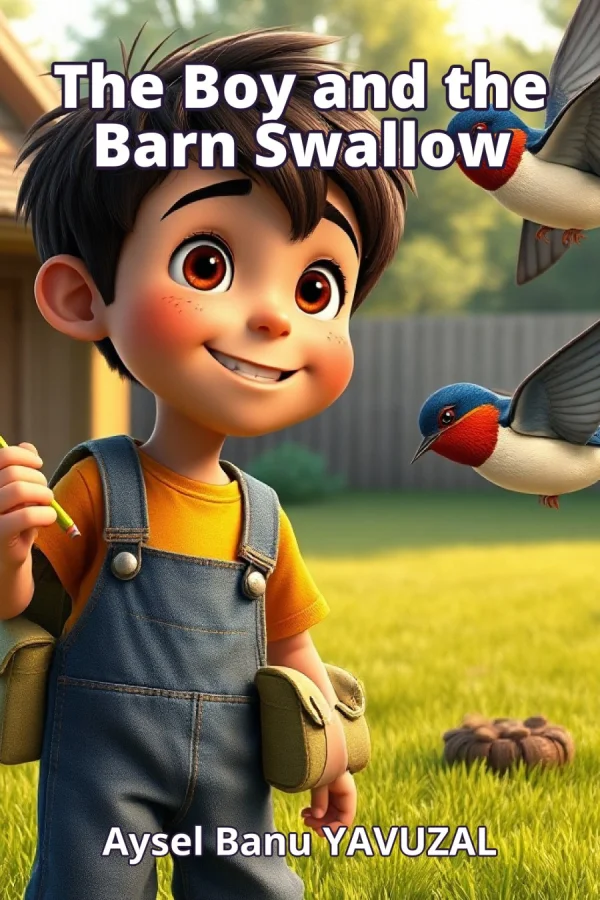
The Boy and the Barn Swallow
Aysel Banu YAVUZAL
- Category Children's Fairy Tales
- Format PDF
- Size 11.8 MB
- Views 1
Leo is an eight-year-old boy who lives in a small town with wide green yards, and every spring he watches the barn swallows return to build their mud nests under the eaves. With his notebook and pencil he draws their forked tails and rusty orange throats, notices how they catch insects in midair and feed their babies, and greets them as little friends. When the swallows gather on the telephone wires one crisp fall morning and fly away until they are tiny specks, the yard feels empty and Leo wants to know where they have gone.
His search takes him to the library, where big books reveal that barn swallows migrate thousands of miles each fall. Leo spreads a sheet of paper on the floor and draws his town at the bottom, then traces the birds' route across rivers, mountains, oceans and deserts all the way to South America, adding tiny swallows and the places where they might rest. His map grows colorful and detailed, and when his teacher sees it she invites him to present it to the class, where he explains that nature connects us all.
Through the winter Leo keeps the map on his wall, and when a familiar twitter sounds one spring morning he runs outside to find the swallows home again. The story shows young readers how curiosity and patient observation can turn a backyard into a doorway to the wider world, and it gently teaches that the same small birds link distant places and the children who watch them. It suits children in the early school years, parents and teachers looking for a quiet tale about nature, migration and gratitude.
Read the Book
If the PDF does not appear, open it in a new tab.
A Chapter from the Book
The Boy and the Barn Swallow - Author : Aysel Banu YAVUZAL
In a small town with wide green yards, a boy named Leo watched the sky every day. He was eight years old, with light brown skin, messy dark brown hair, and big hazel eyes full of wonder. Freckles danced across his nose, and when he smiled, a tiny gap showed between his front teeth. He wore a mustard yellow t-shirt, blue denim overalls, and red sneakers. In his green canvas satchel, he always carried a pencil and a rolled paper map. 1
Every spring, barn swallows returned to Leo's yard. They were glossy steel-blue with rusty orange throats and long forked tails. They swooped and chattered, building mud nests under the eaves. Leo sat quietly on the porch, watching them glide. 'Hello, little friends,' he whispered. The swallows seemed to nod as they flew. They were swift, graceful, and loyal, returning year after year. 2
Leo loved to observe nature. He kept a small notebook in his satchel and drew the swallows' forked tails and bright throats. He noticed how they caught insects in midair and fed their babies. 'You are the best flyers,' he said. The swallows twittered back. Leo felt happy watching them. He wanted to know everything about these wonderful birds. 3
One crisp fall morning, the swallows gathered on the telephone wires. They chattered loudly, as if saying goodbye. Then, one by one, they flew up and away. Leo watched until they were tiny specks. 'Where are you going?' he wondered. The yard felt empty without them. He missed their cheerful calls and graceful flight. 4
Leo decided to find out. He walked to the library and found big books about barn swallows. He read that they migrate thousands of miles each fall. 'They fly across the world!' he gasped. The books showed maps with arrows. Leo borrowed the books and studied them at home. He learned about migration and the journey these small birds take. 5
Leo spread a big sheet of paper on the floor. With his pencil, he drew his town at the bottom. Then he traced the swallows' journey. He drew lines across rivers, mountains, and oceans. He labeled faraway lands with names he could barely pronounce. 'They go all the way to South America!' he told his mom. His eyes sparkled with excitement. 6
Each day after school, Leo added more to his map. He drew tiny swallows along the route. He marked the places where they might rest. He imagined them flying over forests and deserts. 'Do they see giraffes?' he asked. 'No, silly,' he laughed at himself. But the map made the world feel smaller and more connected. 7
Leo's map grew colorful and detailed. He used blue for oceans, green for forests, and yellow for deserts. He drew the swallows with their forked tails, following the arrows. His friends asked about it. 'It's the swallows' journey,' Leo explained. 'They connect our town to faraway places.' His friends were amazed. 8
One day, Leo's teacher saw the map. 'What a wonderful project!' she said. She invited Leo to share it with the class. Leo stood proudly and pointed to the route. 'The swallows fly from our town all the way to South America,' he said. 'They stop at many places. Nature connects us all.' The class clapped. 9
Leo learned that the same swallows that nested in his yard might visit other towns and countries. He thought about children in faraway lands watching the same birds. 'We share the swallows,' he realized. 'We are connected.' He added small drawings of children waving to the swallows. The map became a story of connection. 10
That winter, Leo often looked at his map. He imagined the swallows flying over warm forests and wide rivers. He wondered if they missed his yard. 'Come back soon,' he whispered. He kept the map on his wall. It reminded him that the world is full of wonders and that nature links us all. 11
One spring morning, Leo heard a familiar twitter. He ran outside. There, swooping over the yard, were the barn swallows! They landed on the wires and chattered as if telling stories of their journey. 'You're back!' Leo cheered. He looked at his map and smiled. The swallows had traveled thousands of miles, and now they were home. 12
Leo watched the swallows build their nests again. He knew they would stay all summer. He felt happy and grateful. The map on his wall showed the incredible journey. It reminded him that even small birds can connect distant places. 'You are travelers,' he said. 'And you bring the world together.' 13
Leo decided to share his map with the whole town. He hung it in the library with a note: 'The swallows connect us to the world.' People stopped to look. They traced the route with their fingers. 'I never knew!' they said. Leo felt proud. His map showed that nature connects distant places. 14
From that day on, Leo saw the world differently. Every swallow was a tiny messenger. Every spring brought friends from far away. He knew that the same birds linked his home to places he had never seen. 'What a happy journey!' he thought. And he smiled his gap-toothed smile, ready for another year of watching the skies. 15
Leo learned that nature is a great connector. The barn swallows showed him that even small creatures can travel far and bring people together. He kept his map and his notebook, always ready for new discoveries. And every spring, he welcomed the swallows back with joy, knowing they would return again and again.
This section is a preview taken from the book (about 943 words). To continue, read the book or download the PDF.
Book Details
- Book
- The Boy and the Barn Swallow
- Author
- Aysel Banu YAVUZAL
- Category
- Children's Fairy Tales
- Language
- English
- Format
- PDF · 11.8 MB
- Pages
- 18
- Words
- about 944
- Published
- masalizle.com
- Access
- Free to read and download; for personal use only, all rights belong to the author.
Frequently Asked Questions
Is the PDF of The Boy and the Barn Swallow free?
Yes. The Boy and the Barn Swallow can be read and downloaded for free on this site; no sign-up or payment is required.
How many pages is The Boy and the Barn Swallow?
The Boy and the Barn Swallow has 18 pages and about 944 words.
Which devices can I read The Boy and the Barn Swallow on?
It is a PDF; you can read it in your browser on a phone, tablet or computer, or download it and open it offline.
Who is the author of The Boy and the Barn Swallow?
The Boy and the Barn Swallow was written by Aysel Banu YAVUZAL; it is listed in the Children's Fairy Tales category.